
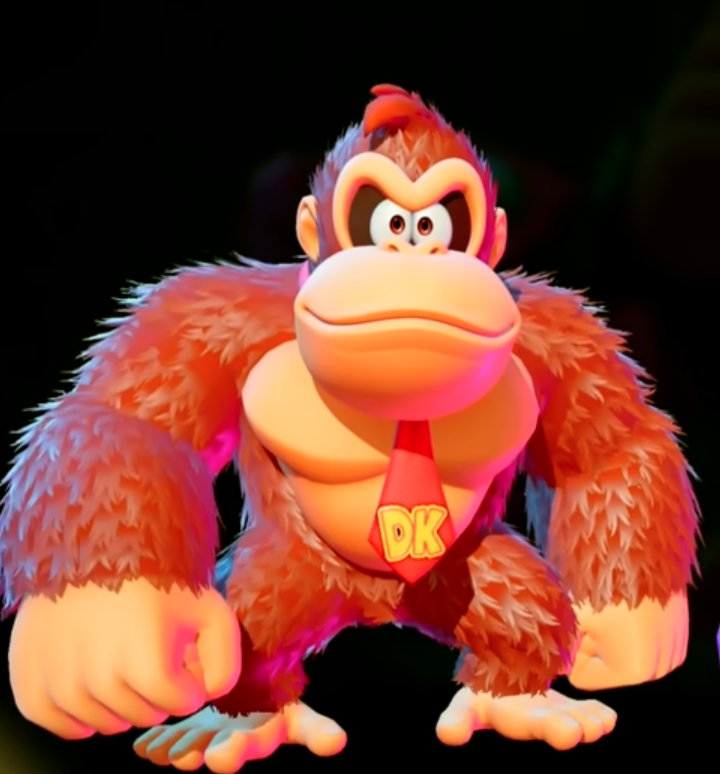
Donkey Kong is, probably, the Nintendo saga with the most volatile trajectory in relation to its fame. From its origins in the arcade, the character has enjoyed popularity typical of the company's most relevant franchises, although the saga's evolution has been irregular across different video game console generations.
We went from the great masterpiece that was the original Donkey Kong Country trilogy on Super Nintendo to tiptoeing through platforms like GameCube. And although it had an acclaimed return on Wii and Wii U with Donkey Kong Country: Returns and Tropical Freeze, it wasn't until the arrival of Nintendo Switch 2 that Nintendo bet heavily again on the industry's most charismatic ape.
In this article, I analyze the unique identity of Donkey Kong Bananza and its most direct influences. Warning: there are spoilers!
What is Donkey Kong Bananza
Donkey Kong Bananza moves away from the 2D that had historically defined the franchise to present Donkey Kong's second three-dimensional adventure. Twenty-six years later, the ape returns joining forces with Pauline on a journey to the center of the Earth to fulfill their wishes. Along the way, they will face the Void Company, a corporation that also pursues that goal and needs Pauline's singing powers to achieve it.
Donkey and Pauline travel through 17 worlds where they will advance by smashing everything in their path. Donkey possesses enough strength to break the scenery itself with his fists, one of the game's most highlighted and innovative points. The map does not regenerate until we leave each world, causing the environment to be deeply altered during exploration and forcing a reinterpretation of the space to find all collectibles.
Although environmental destruction is the most groundbreaking point, Donkey can do much more than that. The gameplay also consists of jumping, climbing, or swimming with surprising fluidity. This mobility is expanded through Bananzas: transformations into different animals that Donkey will acquire throughout the adventure. He can run on brittle ice in zebra form, absorb terrain as an elephant, fly like an ostrich, or bounce as a snake, in addition to becoming a more powerful version of himself in his first transformation.
Each of the worlds is full of collectibles that push the player to explore every corner of the stage. The main ones are the Banandio gems, golden bananas that amount to a thousand and are the axis of progression. Along with them, we find hundreds of fossils inspired by the Kong universe, which can be exchanged for clothes for the protagonists.
Donkey Kong is not one of those sagas with clear continuity like Mario or Zelda. Bananza does not present itself as a natural evolution of Tropical Freeze nor, after so many years, as a direct continuation of Donkey Kong 64. In fact, if I think about the game's main DNA, the closest reference that comes to mind is Super Mario Odyssey.
The influence of Super Mario Odyssey
Being developed by the same team, I feared finding a Super Mario Odyssey disguised as Donkey Kong. And, in effect, both games share many similarities, especially regarding narrative concept and gameplay structure.
Both progression arcs are similar: sandbox worlds that culminate with a boss and connect to the next world. In both cases, we have a very similar difficulty curve, with the first worlds being very (but very) easy and showing a more complex postgame (special mention to the darker side of the moon in Odyssey).
Collectibles also fulfill an equivalent role: In Odyssey, the Power Moons and coins; in Bananza, the Banandio gems and fossils, which also serve to unlock clothes for our protagonists.
Despite these similarities, Bananza offers a very different experience. While Mario transformed into enemies with Cappy, Donkey alters the environment with his fists. His rolls, jumps, climbs and, above all, the transformations through the different Bananzas turn the gameplay into something completely its own.
Although both game concepts start from free exploration, the mechanics of each differentiate them radically.
For all this, I see Bananza as a spiritual sequel to Odyssey. But I absolutely do not see Donkey as a possible transformation of Cappy. Donkey Kong Bananza opens up a very different idea to Odyssey, endowing it with a concept of its own in every right.
The influence of Rare and the reconciliation of universes
Donkey has always moved between two universes: Nintendo's and the one created by Rare. Being a game developed by Nintendo itself, when I saw the presentation trailer, many of its elements made me presage that Bananza could suppose a reboot in the saga and therefore a shelving of Rare's legacy.
Donkey presents a new image, inspired by The Super Mario Bros. Movie and premiered on console in Mario Kart World. His design, more cartoonish and expressive, moves away from the serious tone of the Country games of the original trilogy. If we add the fact that the adventure's co-star is Pauline, a historically forgotten character but with a major role in (surprise!) Odyssey, this made me fear a greater distancing from the Rare universe and at the same time, a return to Donkey's origins.
However, Nintendo embraces Rare's legacy more than seen in recent installments. At the beginning, we find classic characters like Cranky and Rambi, and later on, the former stars Diddy and Dixie, with whom we will recall the events of the original trilogy.
The small 2D phases throughout the adventure are clearly inspired by the classic games. We can even visit Donkey's house from the first Country or advance through a level dominated by blast barrels that recall the second installment.
The music, as fantastic as always in the Country saga, remains intact, evoking classic themes like "Stickerbush Symphony" and adding themes like "Heart of Gold", performed by Pauline herself.
But the most nostalgic moment we live is when we reach the center of the Earth. Not only do we see classic saga enemies, like Kremlings, Zingers, or Armys; we also face King K. Rool, the forgotten enemy par excellence of Donkey Kong, for the first time in decades.
The reconciliation between the Nintendo and Rare universes occurs when Donkey and Pauline battle King K. Rool in New Donk City, one of the most emotional and climactic moments of the game.
Throughout the adventure, constant nods appear in the form of fossils shaped like animals or enemies from the original trilogy. The Fractones remind of Banjo-Kazooie, a subtle and nostalgic homage to Rare. Even in the controversial DLC, we travel to DK Island with the setting seen on Nintendo 64, where we will find old friends like Squawks the parrot.
The future of Donkey Kong
The Donkey Kong saga has had complex continuity over the years. Nintendo, as with Mario or Kirby, does not delve into explaining its universe, so Pauline's role as Donkey's partner leaves it unclear if we are facing a narrative reboot. Fans will continue speculating if this Pauline is the granddaughter of the original one kidnapped by Cranky or the same protagonist from Odyssey. Beyond these theories, Bananza has left me with the feeling that Nintendo does not intend to erase Rare's legacy, but to fuse it with its own universe. Will we see Dixie star in a game again as she did in 1996? I don't think so: Nintendo's original work is clearly Donkey. However, everything points to us continuing to see classic Rare characters in future installments.
Nintendo's bet on the saga gives me hope that Donkey could provide much more gameplay in the future than he has in the last 25 years. Nintendo's main sagas feature a hero, a main ability, and a clear antagonist. Link has the Master Sword to fight Ganondorf. Yoshi transforms enemies and throws eggs at Baby Bowser. Mario jumps on Bowser. And although I would like to say that I hope we can see Donkey breaking mountains and punching King K. Rool in many more installments, the only thing we know for certain is that Bananza consolidates Donkey Kong as a saga as relevant and brilliant as Mario and Zelda.
Original text written in Spanish. Translated using IA.
Me parece un gran juego, tiene lo que te da un Mario en 3D pero sin perder la esencia de Donkey Kong, muy divertido 😁
Un gran juego a la altura de los mejores Mario 3d. Es una lástima que jamás vaya a vender tanto como ellos porque se lo merece.
Nice article. Replying in english because this is my preferred language. I actually have not played Bananza just yet, but I bought it already as a chistmas present for my kid. Very happy to hear that Rare legacy is reflected then. There is nothing better than cross generational nostalgia and the whole idea of making my kids experienced what I experience when I was their age is very gratifying.