
It has been 30 years since the release of Pokémon Red and Green in Japan. The franchise was not only a revolution for the industry, revitalizing a Game Boy that seemed to be on its last legs and serving as a major benchmark for many subsequent games, but it also had a huge impact on popular culture, cementing itself in the hearts of millions of people through the anime, movies, plushies, and so much more merchandise. But if we go back to the starting point, our beloved original games for Nintendo's handheld, we see that a large part of their success was rooted in something very specific: collecting.
Pokémon Red and Blue: the scarcity that set the value
The first generation of Pokémon established a premise for the franchise. A kid from a small town becomes a trainer when a professor gives him the chance to start his adventure alongside a Pokémon, choosing from three options. On that first journey, they were Bulbasaur, Charmander, and Squirtle. The trainer had to catch Pokémon, make them battle to make them stronger, and thus face 8 gym leaders in order to open the doors to challenge the Pokémon League, made up of the fearsome Elite Four and the regional Champion. If the trainer emerged victorious, he became the new Champion. But beyond that challenge, the professor urged the trainer to catch at least one specimen of every Pokémon in the region. And it is precisely that collecting factor that made Pokémon so addictive.
In the original versions, the vast majority of Pokémon encounters occurred when the player stepped into the tall grass, with one of them appearing randomly. Many of them were very common, and we would find them constantly along the routes connecting the cities of Kanto. However, others played hard to get.
Some examples are Clefairy in Mt. Moon or Jigglypuff on Route 3. Their encounter rate was very low and they could not be found outside of those places. However, with some patience and luck, in less than an hour of roaming the area, you could get at least one specimen.
Much more extreme were the cases of the legendary Pokémon: Mewtwo, Articuno, Zapdos, and Moltres. There was only one of each in the game, and we had a single chance to catch them. Similar was the case of Snorlax, with only two available in the middle stretch of the adventure. These always played a fundamental role in the character's development as a trainer. They are very strong Pokémon that considerably elevate the team's strength and prestige. However, every player could acquire them, making them rarer in the saga's lore than their actual obtainment in the game.
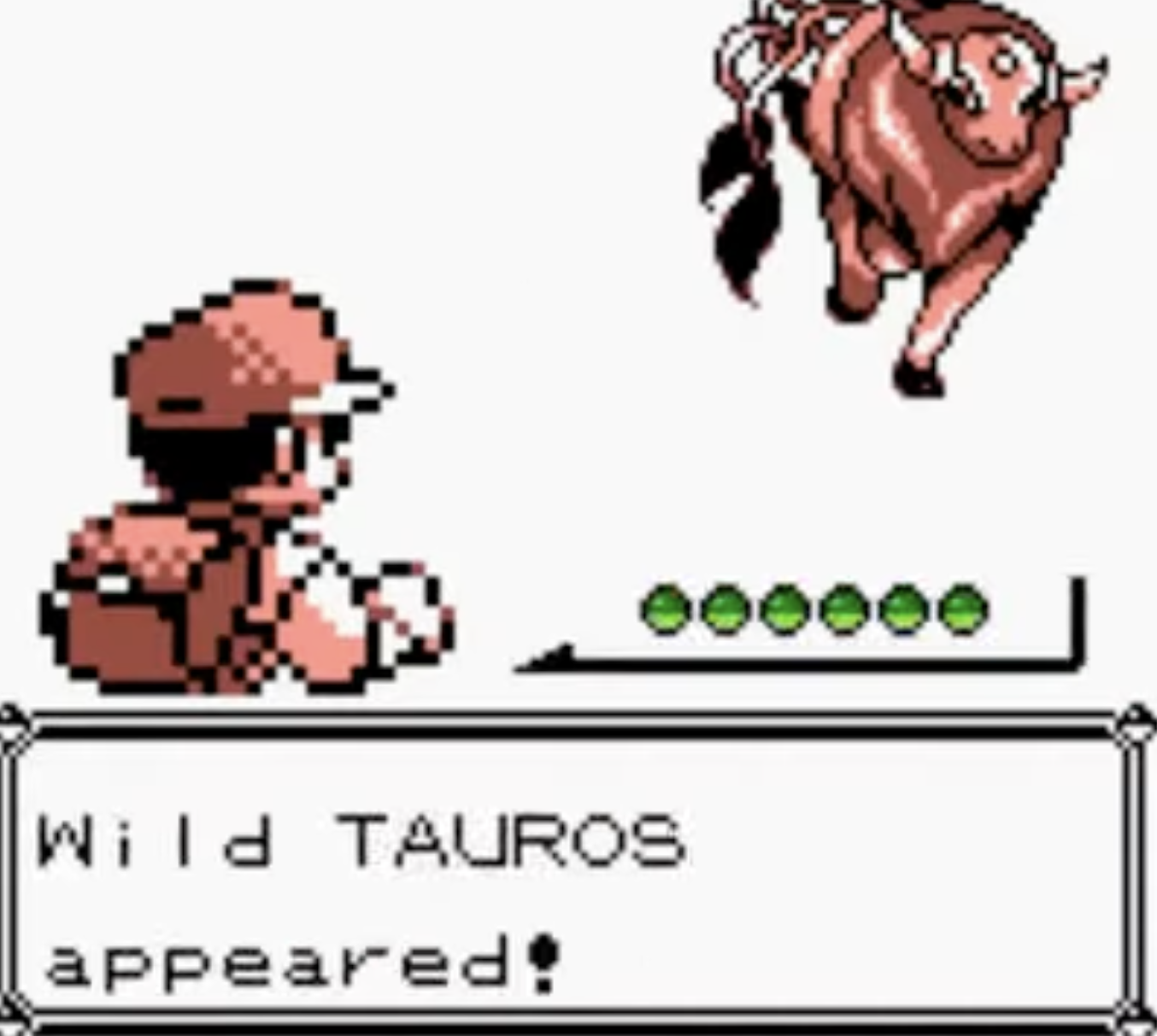
The Safari Zone was another headache when trying to catch several of them, with the most elusive being Tauros and Kangaskhan. While Mewtwo had a legend behind it, catching Tauros or Kangaskhan was much more complicated. Not only was their encounter and catch rate very low, but they could also flee while you were trying to catch them. Nor could we weaken them in combat, a fundamental mechanic for facilitating catches in the rest of the region. Catching one of them took hours and hours, assuming the player hadn't lost their patience in the attempt.
The next degree of exclusivity centered around those Pokémon that we could only find in one of the game's versions, and which required trading with another player to obtain them. Some examples were the bug Pokémon Scyther and Pinsir, or the evolutionary lines of Oddish and Bellsprout. However, as long as we had a friend with the opposite edition, it was relatively easy to get them. That being said, we also needed a friend to obtain Pokémon that only evolve through trading, such as Gengar or Golem.
The ultimate Pokémon scarcity, and what made them truly valuable, was the case of those whose obtainment became impossible upon making decisions during the adventure. In fact, the first example is the game's starters, something we would see across all generations. At the beginning of the adventure, we choose between Bulbasaur, Charmander, and Squirtle, and once we decide on our starter Pokémon, we can never again opt to get the other two during the adventure. The only way was to find a friend willing to give us their Pokémon. The same happened mid-adventure when choosing between the Dome and Helix fossils, which would allow us to obtain Kabuto and Omanyte, respectively. Something similar also happened with the versatile Eevee and its multiple evolutions. There is only one specimen of it in the game, and we must choose its evolution, letting go of the possibility of having the remaining two evolutions.
Of course, we haven't forgotten about Mew. This was a mythical Pokémon that couldn't be obtained in any of the video games, except through a glitch that allowed you to catch it. The legend of obtaining Mew generated a fever among players. We all wanted one, and more than one player (myself included) wasted hours using Strength against a certain truck in the Vermilion City port.
New mechanics and the loss of exclusivity
Over time and across generations, new mechanics were introduced that facilitated the possibility of completing the Pokédex. The ability to breed Pokémon eliminated the exclusivity of any that could be bred. It is true that starting in the third generation, the Pokémon featured on the game's cover became exclusive to that edition, also always being a unique legendary in the adventure. However, throughout the generations, especially from the sixth onwards, it became increasingly accessible (though equally laborious) to complete an ever-expanding Pokédex, up until the famous National Pokédex cut in the eighth generation. The use of the defunct Pokémon Bank or the current Pokémon Home, online trading, or Nintendo's events to give away legendary Pokémon has made completing the Pokédex not as complex as in the early editions. And surely that is why, when we see a wild Eevee in a new edition, we rush to catch it as if it were a once-in-a-lifetime opportunity. And for that and a thousand other reasons, that first generation will always be special.
Original text written in Spanish. Translated using IA.
Se echan de menos los juegos de Pokémon clásicos... A ver si con la décima generación se empieza a recuperar ese espíritu!
Muy buen artículo, es inevitable volver a aquella niñez con Pokémon rojo en mi caso, han envejecido muy bien estos juegos, me han entrado ganas de empezarlo de nuevo 😍