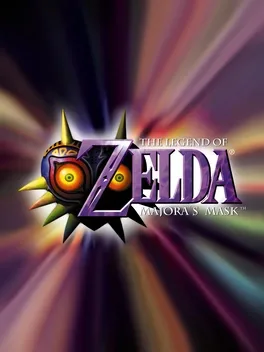
The Legend of Zelda: Majora's Mask
Introduction
Following the monumental success of its predecessor, The Legend of Zelda: Majora's Mask emerged as a haunting and beautiful departure from the standard fantasy formula. Often abbreviated by the gaming community as TLoZ: MM or LoZ: MM, this title is widely regarded as the darkest entry in the franchise. It broke away from the traditional Ganon-centric plot to deliver a personal, time-sensitive quest that focuses on loss, regret, and the inevitable passage of time.
Story & Setting
Unlike most adventures in the series, this story takes place outside of Hyrule in the doomed land of Termina. Link, while searching for a lost friend, is ambushed by a masked Skull Kid who has stolen a powerful artifact and cursed Link. During development, the project was known as Zelda Gaiden (or ゼルダの伝説 外伝 in Japanese), indicating its experimental nature. In this strange world, a terrifying moon hangs in the sky, destined to crash within three days. To stop the apocalypse, Link must seek help from the Four Giants while contending with the mysterious Happy Mask Salesman. This narrative journey, titled Zelda no Densetsu: Majora no Kamen in Japan and 塞尔达传说-魔力面具 in China, remains one of the most conceptually daring stories in the Zelda timeline.
Gameplay
Retaining the engine and visual style of Ocarina of Time, the gameplay blends traditional action-adventure with a unique three-day time cycle. Players have 72 in-game hours to complete their task before the moon falls. Using the Ocarina of Time, Link can play melodies to slow time or reset the cycle entirely. This installment is heavily oriented toward NPC interactions; the Bombers' Notebook tracks the complex schedules of Termina's citizens. Core mechanics include active shield blocking, various throwing items, and the use of melodies to solve intricate puzzles. Specifically, transformation masks allow Link to change forms, gaining abilities specific to the Deku, Goron, and Zora races. The abundance of optional quests, such as the famous Anju and Kafei side story, and diverse mini-games, makes the world feel dense and interconnected. This version boasts a larger variety of items and collectibles compared to previous Zelda games.
This game was released on several platforms, including the Nintendo 64 and various digital services for later hardware like the Wii and Wii U.
Legacy
The legacy of Majora's Mask is one of cult devotion and critical reappraisal. While its initial release was overshadowed by its predecessor, its reputation has grown significantly. It is frequently cited as one of the greatest games of all time, noted for its emotional intelligence and atmospheric dread. The game’s willingness to reuse assets from Ocarina of Time allowed the developers to focus on depth rather than breadth, creating a lived-in world that feels more intimate than almost any other game of its era. Its impact is still felt today, having received a full 3D remake on the Nintendo 3DS.
Fun Facts
- The development team was given only one year to complete the game, leading to the creative use of existing assets and the time-loop mechanic.
- It was one of the few games on the Nintendo 64 to require the Expansion Pak for its advanced memory management.
- The haunting Elegy of Emptiness statue became the subject of the famous Ben Drowned internet creepypasta, cementing its place in modern digital folklore.
- In its early stages, the game was intended to be an expansion for the 64DD peripheral.