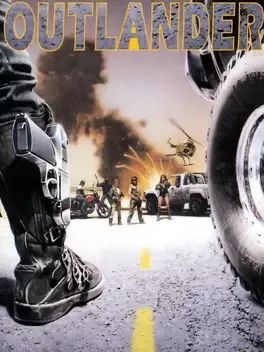
Outlander
Introduction
Step into a scorched earth where the law of the land is dictated by the roar of an engine and the blast of a shotgun. Outlander, released in the early 1990s, stands as a gritty testament to the post-apocalyptic obsession of the 16-bit era. It is a game that captures the essence of survival against impossible odds, placing players in the driver’s seat of a high-powered interceptor tasked with traversing a wasteland filled with marauders. Whether you are speeding through the desert or navigating the ruins of a town on foot, Outlander delivers a relentless experience where there is truly no turning back. As one of the few games of its time to successfully blend vehicle combat with side-scrolling action, it remains a fascinating relic of early 90s game design.
Story & Setting
The narrative of Outlander is one of desperation and grit. The world as we know it has crumbled, leaving behind a barren landscape where resources are the only currency that matters. As the game’s premise states, the hopes of the human race are riding on you; you are their only chance at survival. This isn't a hero's journey filled with glory, but a grim slog through a world that wants you dead.
You play as a lone driver moving between settlements in a desperate bid to deliver vital supplies and reach safety. To go forward, you'll have to fight your way in—through biker gangs, armed convoys, and desperate scavengers—and then pray you can get out. The setting is heavily inspired by wasteland cinema, featuring sun-bleached roads, makeshift fortresses, and a sense of isolation that few games of the time managed to replicate so effectively. Every mile traveled is a victory, and every oasis found is a temporary reprieve from the surrounding chaos.
Gameplay
The gameplay of Outlander is unique for its time, split into two distinct modes: high-octane driving and side-scrolling action. During the driving segments, players view the action from either a first-person or third-person perspective (depending on the console version), steering through obstacles while fending off enemy vehicles. You aren't just driving; you are a mobile weapon. You can fire forward-mounted guns or use window-mounted weapons to take out bikers flanking your position. Monitoring your dashboard is crucial, as you must keep an eye on your fuel levels and engine temperature.
However, your car requires fuel and maintenance to stay operational. To find these resources, you must frequently pull over and enter towns or outposts. This shifts the perspective to a side-scrolling action game. On foot, you must navigate treacherous environments, scavenging for food, water, and ammunition while engaging in hand-to-hand combat or shootouts with wasteland thugs. This resource management adds a layer of strategy; if you run out of fuel on the road, your journey ends abruptly, making every stop a high-stakes gamble for survival. The difficulty is notoriously high, requiring players to be precise with their shots and frugal with their supplies.
This game was released on several platforms, including the Sega Mega Drive/Genesis and the Super Nintendo Entertainment System (SNES).
- SEGA MEGA DRIVE/GENESIS: NTSC-U
- SUPER NINTENDO ENTERTAINMENT SYSTEM: PAL, NTSC-U
Legacy
Outlander occupies a fascinating space in gaming history. While it was not a massive commercial blockbuster at the time of its release, it is remembered fondly by retro enthusiasts for its ambitious scope and oppressive atmosphere. It successfully blended genres that were usually kept separate, providing a "road movie" experience that felt cohesive and cinematic despite the technical limitations of the 16-bit hardware.
The game is often cited as one of the best "non-licensed" licensed games. Its aesthetic and mechanics so closely mirror the Mad Max series that it has become a cult classic for fans of that franchise. For many players in the 90s, this was the definitive post-apocalyptic simulator, offering a level of difficulty and bleakness that was rare in an era dominated by colorful, lighthearted platformers. Today, it is frequently revisited by collectors who appreciate its unique hybrid gameplay and its bold attempt to bring the "interceptor" fantasy to life.
Fun Facts
- The game was originally developed by Mindscape as an official Mad Max tie-in. Due to licensing issues near the end of development, the name was changed to Outlander, though the similarities to the film The Road Warrior remain unmistakable.
- There are notable differences between the console versions. The Genesis version features a first-person "in-car" view for driving, which adds to the immersion, while the SNES version utilizes a third-person "behind-the-car" view.
- The game features a sophisticated (for its time) damage system where players have to manage the health of specific car parts, such as tires and the engine, rather than just a single health bar.
- In the side-scrolling sections, players can find a variety of weapons, including shotguns and chainsaws, which were clear nods to the action movies of the 1980s.