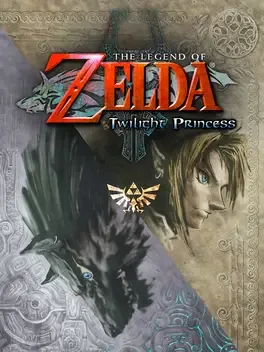
The Legend of Zelda: Twilight Princess
Introduction
The Legend of Zelda: Twilight Princess stands as a monumental achievement in gaming history, bridging two console generations and fulfilling a long-standing fan desire for a darker, more realistic Hyrule. Often abbreviated as LoZ: TP, this title moved away from the cartoonish aesthetics of its predecessor to deliver an experience that felt both grounded and ethereal. Upon its reveal, the gaming community erupted in anticipation, viewing it as the spiritual successor to the grounded tone established in the Nintendo 64 era. For many, it represented the ultimate realization of the series' potential on the hardware of its time, blending a somber atmosphere with the high-adventure spirit that defines the franchise.
Story & Setting
The narrative unfolds across several sprawling provinces, where a mysterious shroud known as the Twilight Realm begins to consume the light of Hyrule. The story follows Link, a young farmhand from Ordon Village, who is thrust into a struggle to save his world from eternal darkness. As the Twilight spreads, Link is transformed into a beastly wolf, leading to a fateful encounter with Midna, a mischievous creature from the shadow realm. Together, they traverse a landscape caught between dimensions, working to stop the usurper king Zant. The world is vast, featuring diverse landscapes ranging from the scorching peaks of Death Mountain to the flooded depths of Lake Hylia, all rendered with a naturalistic art style that emphasizes the scale and weight of the journey.
Gameplay
At its core, the gameplay retains the classic exploration and dungeon-crawling the series is known for, but with a transformative twist. Link gains the ability to transform into a Wolf upon entering the Twilight. In this form, the gameplay shifts toward tracking and puzzle-solving using heightened wolf senses, which allow him to see spirits and follow scent trails. As a wolf, he can also dig into the earth to find hidden secrets, hearts, and rupees. When in human form, Link employs traditional swordplay, which is expanded through the teaching of Hidden Skills by a mysterious spectral mentor. The dungeons and temples are noted for their complex architecture and inventive use of items, requiring players to constantly switch between Link’s forms to navigate the environment and defeat formidable bosses.
This game was released on several platforms, including the Nintendo GameCube and the Wii, ensuring its reach across a broad audience.
Legacy
Known as 塞尔达传说: 黄昏公主 in Chinese-speaking regions and 젤다 황공 in Korea, the game has received universal acclaim since its launch. Critics and journalists have frequently cited it as the greatest Zelda game of all time, praising its mature art style and the emotional depth of its characters. It was seen as a direct response to those who wanted a more mature visual direction than the cel-shaded look of previous entries. Its influence is still felt in the franchise today, particularly in how it balanced traditional dungeon design with a more cinematic approach to storytelling. By returning to the aesthetic roots of Ocarina of Time, it solidified its place as a fan favorite for those who prefer the series' more serious, naturalistic side.
Fun Facts
Interestingly, during the very early stages of its development, the project was internally conceptualized as The Legend of Zelda: The Wind Waker 2 before the team pivoted toward a more realistic tone. In Japan, the title is formally known as Zelda no Densetsu: Twilight Princess. Another fascinating bit of trivia involves the game's orientation; because the Wii version utilized motion controls, the entire game world was mirrored to make Link appear right-handed for the majority of players. This means that the GameCube version is the only version of the game where the map of Hyrule is oriented correctly relative to previous entries in the series timeline.