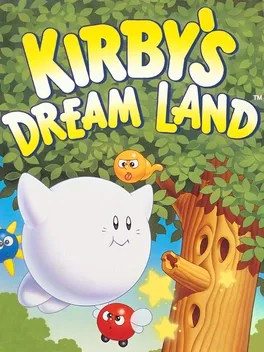
Kirby's Dream Land
Introduction
Kirby's Dream Land is a landmark title in the history of handheld gaming, marking the 1992 debut of one of Nintendo’s most enduring and beloved icons. Developed by HAL Laboratory and directed by a young Masahiro Sakurai, the game was specifically designed to be an accessible platformer that anyone could pick up and enjoy. While many games of the early 90s were known for their punishing difficulty, Kirby took a different path, offering a charming, breezy adventure that focused on joy and creativity. Despite being a relatively short experience, its polished mechanics and whimsical presentation established a formula that would be refined over dozens of sequels and spin-offs, making it a must-play classic for fans of the genre.
Story & Setting
The narrative of Kirby's Dream Land is a simple yet effective tale of heroism. In the peaceful kingdom of Dream Land, the inhabitants find themselves in distress when the gluttonous King Dedede steals every scrap of food for a midnight feast. Not content with just a snack, Dedede also makes off with the kingdom's Sparkling Stars, which are essential for the land's prosperity. Kirby, a brave and surprisingly hungry resident, takes it upon himself to recover the stolen goods and restore order. Known in Japan as Hoshi no Kirby and in Korea as 별의 커비 (or 커비스 드림랜드), the game takes players through a variety of imaginative environments. From the lush greenery of the first stage to the ethereal, cloud-based heights of the later levels, the setting is consistently vibrant, even within the limitations of the original hardware's monochrome display.
Gameplay
The gameplay of Kirby's Dream Land follows the side-scrolling conventions of the 8-bit era but introduces several unique mechanics that set it apart from its contemporaries. Kirby's primary method of interaction is his ability to inhale enemies and objects. Once inhaled, Kirby can either swallow the enemy or spit them out as a powerful star projectile to defeat other foes. Another defining characteristic is Kirby's flight. By inflating himself with air, he can hover and fly across the screen indefinitely, which provides a layer of safety not found in most platformers. While the game does not yet feature the 'Copy Ability' mechanic that would define later entries, it offers varied level design and memorable boss encounters. It is important to note that, typical for its time, the game lacks a save function. Scores are not recorded once the system is turned off, and there are no save files; players must complete the journey in one sitting or restart from the beginning if the power is cut or the game is reset.
This game was originally released for the Game Boy and has since been made available on newer hardware through various digital distribution services and collections.
Legacy
The legacy of Kirby's Dream Land is felt in almost every mascot-driven platformer that followed. It successfully proved that games did not need to be frustratingly difficult to be engaging. The title’s success allowed Masahiro Sakurai to grow into one of the industry's most influential figures, eventually leading to the creation of the Super Smash Bros. series. The simple, circular design of Kirby has become a piece of pop culture iconography, and the music from the first stage, 'Green Greens,' remains one of the most recognizable tunes in gaming history. The title also laid the groundwork for the expansion of the 'Kirby' universe, introducing recurring characters like King Dedede and Waddle Dees who remain staples of the franchise to this day.
Fun Facts
Before he was the pink puffball we know today, Kirby was actually a placeholder sprite named Twinkle Popo. The development team at HAL Laboratory eventually fell in love with the simple design and decided to keep it as the final protagonist. Interestingly, Kirby's color was a point of contention during early development; while Sakurai wanted him to be pink, Shigeru Miyamoto initially suggested he should be yellow. This confusion led to Kirby appearing as a white character on the North American box art, as the monochrome Game Boy screen left his true color up for debate. Additionally, for those seeking a greater challenge, the game features a secret 'Extra Game' mode. By pressing a specific button combination on the title screen, players can unlock a much harder version of the adventure with new enemy patterns and more aggressive bosses.