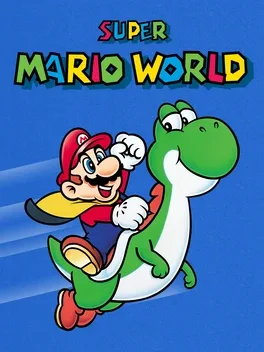
Super Mario World
Table of Contents
Introduction
When the Super Nintendo Entertainment System (SNES) launched, it needed a flagship title to demonstrate the power of 16-bit gaming. That title was Super Mario World. Known in Japan as Super Mario Bros. 4: Super Mario World (or simply マリオワールド), and referred to by fans globally as SMW, this masterpiece redefined the platforming genre. Whether you know it as 超级马力欧世界 or by its classic Western title, there is no denying that this game is one of the most influential pieces of software ever created. It took the foundation laid by its predecessors on the NES and expanded it into a sprawling, vibrant world full of secrets and technical innovations that still hold up today.
Story & Setting
The narrative begins with Mario, Luigi, and Princess Peach taking a well-deserved vacation to Dinosaur Land. However, the peace is short-lived as the villainous Bowser once again abducts the Princess. To make matters worse, Bowser has also imprisoned the local residents—dinosaurs—within magical eggs. Mario and Luigi must traverse the vast reaches of Dinosaur Land, defeating the Koopalings and Bowser’s various underlings to restore order and save Peach from his clutches. Unlike the Mushroom Kingdom, Dinosaur Land is divided into several distinct regions, such as Yoshi's Island, Donut Plains, and the treacherous Valley of Bowser, each offering a unique aesthetic and set of challenges that pushed the boundaries of the series' world-building.
Gameplay
The gameplay of Super Mario World was a massive leap forward for the franchise. While the core objective remains reaching the goal post at the end of each stage, the introduction of Yoshi, the lovable green dinosaur, changed the mechanics entirely. Players can ride Yoshi, who can swallow enemies and gain special abilities—like fire-breathing or flight—depending on the color of the shell he eats. Another major addition is the Cape Feather, which allows Mario to fly and glide across long distances, adding a significant vertical dimension to level exploration.
Technically, the game introduced a much less linear world map than previous entries. Many levels contain secret exits, marked by red dots on the map, which unlock hidden paths, Star Road shortcuts, and the legendary Special World. This encouraged exploration and completionism, rewarding players for thinking outside the box. Furthermore, the inclusion of a save system—a first for the main series—allowed players to tackle the massive 96 exits at their own pace. The technical power of the SNES also enabled "Mode 7" rotating effects and a richer color palette, making the world feel more alive than ever before.
This game has been made available across various generations of Nintendo hardware, ensuring that players can experience this classic on both original and modern systems.
Legacy
The legacy of Super Mario World is unparalleled in the industry. It is frequently cited as one of the greatest video games of all time, proving that the transition from 8-bit to 16-bit was about more than just higher-resolution graphics; it was about depth, sound, and scope. The game's soundtrack, composed by Koji Kondo, is iconic for its use of a central theme that is rearranged in different styles (calm, athletic, underground) throughout the game. SMW also fostered a massive "ROM hacking" community, which continues to create new levels and challenges decades later. Its influence can be seen in every subsequent 2D Mario title, especially the Super Mario Maker series, which borrows many of its physics and assets.
Fun Facts
- In Japan, the original box art prominently featured the title Super Mario Bros. 4, establishing it as the direct successor to the NES trilogy.
- Yoshi was actually envisioned by Shigeru Miyamoto since the development of the original Super Mario Bros., but the NES hardware wasn't powerful enough to handle a mountable character.
- Completing the "Special World" triggers a permanent color palette swap for the entire overworld and transforms several enemies into strange, alternate versions (like Koopas wearing Mario masks).
- The game's music is largely based on a single melody that is transformed through various instrumentation to suit the level's environment.