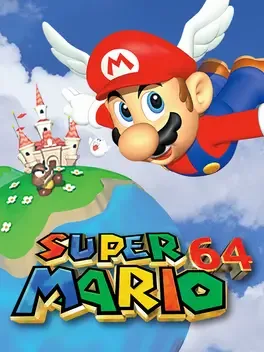
Super Mario 64
Introduction
When the Nintendo 64 launched in the mid-1990s, the video game industry was on the cusp of a massive dimensional shift. Super Mario 64 was the vanguard of this revolution. Often referred to by the shorthand SM64, it was not just a sequel to the beloved 2D platformers of the past; it was a fundamental reimagining of what a video game could be. By providing a sandbox for movement and exploration, Nintendo set the blueprint for every three-dimensional adventure that followed. Today, it remains a masterpiece of design, proving that great gameplay is truly timeless and that Mario’s transition to 3D was a defining moment in entertainment history.
Story & Setting
The narrative of Mario 64 begins with a simple and sweet invitation. Princess Peach sends a letter to Mario, inviting him to the castle for a homemade cake. However, the serene atmosphere of the Mushroom Kingdom is shattered upon Mario's arrival. The malevolent King Koopa, Bowser, has invaded the castle, imprisoned its inhabitants, and locked the Princess away in the walls. Bowser has stolen the castle's Power Stars and hidden them within the magical paintings that ornament the castle walls. Mario must explore these diverse realms, ranging from sun-drenched battlefields to treacherous volcanic pits, to reclaim the stars and confront his archrival. The castle itself acts as a massive puzzle box, with secrets hidden behind every corner, providing a central hub that feels as alive as the levels themselves.
Gameplay
What truly set Super Mario Rokujuuyon apart from its predecessors was its unparalleled movement system. Mario's arsenal of moves was greatly expanded to include the triple jump, wall kick, side somersault, and the iconic long jump. Players navigate through the castle using an analog stick, which allowed for a degree of precision never before seen in gaming. By jumping into paintings, Mario enters distinct levels where he must complete specific tasks—such as defeating a boss, winning a race against a giant penguin, or solving an environmental puzzle—to earn a Power Star. The game emphasizes exploration and mastery of the 3D space, rewarding players who find creative ways to reach their goals. The camera system, personified by a Lakitu on a fishing pole, allowed players to adjust their perspective manually, which was a necessity for navigating the complex 3D environments.
This legendary title has been made available across several generations of Nintendo hardware, including the nintendo 64, wii and wii u.
Legacy
The legacy of this title cannot be overstated. It essentially invented the vocabulary of 3D platforming. Before its release, developers struggled with how to handle movement and camera controls in three dimensions; Super Mario 64 provided the elegant solution that is still used in modified forms today. Its impact is felt not just in Nintendo's own sequels like Odyssey, but across the entire gaming industry. Even decades later, it remains a staple of the speedrunning community, where players utilize glitches and advanced movement techniques to finish the game in record time. It also saw a unique localized release in China known as Shen You Mario for the iQue Player, further cementing its global reach as a cultural phenomenon that transcends borders.
Fun Facts
One of the most enduring myths in gaming history is the "L is Real 2401" mystery. For years, fans believed a blurry texture in the castle courtyard proved Luigi was hidden in the game. It was only during the 2020 "Gigaleak" that a Luigi model was actually found in the game's source code, confirming he was intended for the game at some point. Additionally, speedrunners utilize a famous glitch called the "Backwards Long Jump" (BLJ) to build up infinite speed and bypass doors that usually require a specific number of stars. Finally, the game was originally intended to have a split-screen multiplayer mode, but the idea was ultimately scrapped due to the technical limitations of the hardware, leaving Mario to save the day as a solo hero.