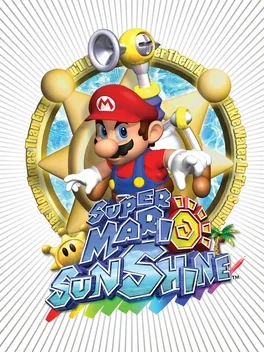
Super Mario Sunshine
Introduction
Released in 2002 for the Nintendo GameCube, Super Mario Sunshine remains one of the most distinct and vibrant entries in the long-running Mario franchise. As the direct successor to the revolutionary Super Mario 64, it was the second 3D Mario platformer ever produced. Often referred to by fans as Mario Sunshine or simply SMS, the game sought to build upon its predecessor's foundation while introducing entirely new mechanics that would challenge the status quo of platforming. Instead of the typical green hills of the Mushroom Kingdom, players were transported to a tropical resort, trading the familiar aesthetic for palm trees, sandy beaches, and crystal-clear water. It was a bold step for Nintendo, emphasizing a cohesive world and narrative focus that was rarely seen in the series at that time.
Story & Setting
The narrative of Super Mario Sunshine begins with Mario, Princess Peach, and her long-time steward Toadsworth embarking on a much-needed vacation to the beautiful Isle Delfino. However, the relaxation is cut short upon their arrival. The island has been polluted with a mysterious, sludge-like goop, and a silhouette resembling Mario—known as Shadow Mario—is seen fleeing the scene of the crime. Accused of the vandalism, Mario is arrested and sentenced to clean the entire island. The setting of Isle Delfino is deeply influenced by Mediterranean aesthetics, paying homage to Mario's Italian heritage. Many of the game's locations feature Italian names, such as Bianco Hills, Ricco Harbor, and Gelato Beach, and the local inhabitants—the burly Piantas and the shell-dwelling Nokis—bring a unique cultural life to the vibrant environment.
Gameplay
The core of the gameplay revolves around the Flash Liquidizer Ultra Dousing Device, or F.L.U.D.D., a sentient water-spraying backpack invented by Professor E. Gadd. This tool completely transforms Mario's movement options. While Mario can still jump and dive, F.L.U.D.D. allows him to hover in mid-air, blast himself high into the sky with the Rocket Nozzle, or move at high speeds across water with the Turbo Nozzle. The gameplay is a masterclass in puzzle-solving and action, as players must navigate multiple stages, each divided into several episodes with varying objectives. Throughout these levels, Mario encounters massive bosses including the iconic Petey Piranha and the multi-tentacled Gooper Blooper. Beyond the water-based mechanics, the game also features hidden "Secret" stages—pure platforming gauntlets where Shadow Mario strips Mario of F.L.U.D.D., forcing players to rely on their raw jumping skills and precision timing.
This game was released on several platforms, including the Nintendo GameCube, as part of its original launch cycle and subsequent regional distributions.
Legacy
Super Mario Sunshine holds a unique place in gaming history. While it was initially met with some controversy due to its high difficulty and the departure from traditional platforming mechanics, its legacy has grown significantly over the decades. It introduced numerous recurring characters and bosses that are now staples of the Mario series, most notably Bowser Jr. and Petey Piranha. The introduction of Shadow Mario also added a layer of mystery that would eventually lead to the reveal of Bowser's son as a major antagonist. Furthermore, the game's high-skill ceiling and complex movement physics have made it a favorite in the speedrunning community. Its tropical atmosphere and the pure joy of its water-based movement ensure that SMS remains a beloved classic for many who grew up in the sixth generation of consoles.
Fun Facts
- The game is filled with references to Italian culture; for example, the word "Pianta" translates to "Plant" in Italian, while "Noki" refers to a type of shellfish.
- This was the first 3D Mario game where the plumber could ride Yoshi, who changes color depending on the fruit he eats.
- Shadow Mario is actually Bowser Jr. in disguise, using a magic paintbrush to create the goop and frame Mario.
- The a cappella music heard in the F.L.U.D.D.-less secret levels is an arrangement of the original Super Mario Bros. theme song.