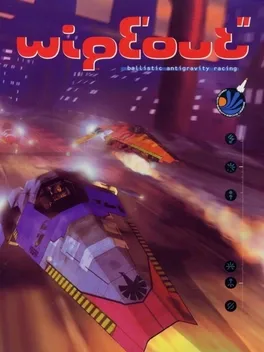
Wipeout
Table of Contents
Introduction
When the original PlayStation launched, it needed a title that didn't just play well but also looked and felt like the future. Enter Wipeout—often stylized as wipE'out"—a game that redefined the racing genre by ditching wheels for anti-gravity engines. Developed by Psygnosis, this title was more than just a piece of software; it was a cultural phenomenon that bridged the gap between the gaming world and the late 1990s electronic music scene. Often referred to by its full title, WipEout: Ballistic Antigravity Racing, the game introduced players to a high-speed, high-stakes environment that demanded lightning-fast reflexes and a taste for neon-soaked aesthetics. It remains one of the most iconic racing experiences in history, standing as a testament to the era's creative ambition.
Story & Setting
The game is set in the year 2052, a time where humanity has mastered anti-gravity technology and applied it to the world's most dangerous sport: the F3600 anti-gravity racing league. This is not the clean, utopian future often seen in older sci-fi; it is a world of corporate sponsorship, gritty industrial landscapes, and cutting-edge engineering. Players take on the role of elite pilots competing in a global championship that pushes the limits of human endurance and technological capability. The tracks are carved into the landscape of the future, featuring dizzying vertical drops, corkscrew turns, and massive jumps that would be impossible for conventional vehicles. In this setting, the F3600 league is the pinnacle of human entertainment, where glory is hard-won and every second counts in the race for the podium.
Gameplay
Gameplay in Wipeout is a frantic mix of precision driving and combat. Players pilot one of several hover-craft across multiple challenging tracks. There are four distinct racing teams to choose from, with each team offering two ships. These ships are categorized by their specific performance metrics: acceleration, top speed, mass, and turning radius. For instance, a heavier ship might be harder to knock off course but will struggle with quick acceleration, whereas a lighter craft might be agile but fragile during collisions. Mastering the physics of anti-gravity is essential. Unlike traditional racers, ships in Wipeout use air brakes to navigate tight corners, requiring the player to balance momentum and friction in a unique way. To add to the intensity, the tracks are fitted with power-up pads. Crossing these pads grants the player various weapons and utilities. Offensive options include rockets, missiles, and shock waves designed to disrupt competitors, while defensive pickups like shields, mines, and turbo boosts help maintain the lead or recover from an attack.
This game was released on several platforms, including the original PlayStation and the Sega Saturn, ensuring its fast-paced action reached a wide audience across different hardware ecosystems.
Legacy
The legacy of Wipeout is inextricably linked to its visual and auditory presentation. By collaborating with the graphic design firm The Designers Republic, Psygnosis ensured the game had a consistent, futuristic aesthetic that stood out on store shelves. The inclusion of a high-energy electronic soundtrack helped the game penetrate the club culture of the 90s, making it a "cool" accessory for adults rather than just a toy for children. It paved the way for numerous sequels and inspired a whole subgenre of anti-gravity racers. Even decades later, the influence of its sleek UI and rapid-fire gameplay can be seen in modern titles that strive for that same sense of kinetic energy and style.
Fun Facts
One interesting piece of trivia is that the game's iconic title, WipEout, was inspired by a desire to convey a sense of extreme speed and consequence. Additionally, the game was so popular in the UK that it was frequently set up in nightclubs as part of the visual entertainment, a move that was revolutionary for marketing games to adults at the time. The difficulty of the original game is also legendary among fans, as the physics were significantly less forgiving than those found in later entries, making a gold medal a true badge of honor for 90s gamers who mastered the F3600 league.