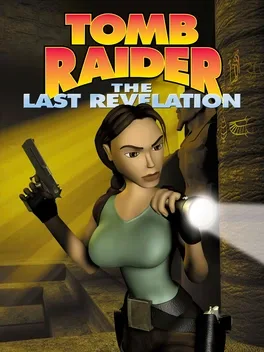
Tomb Raider: The Last Revelation
Introduction
Story & Setting
Gameplay
Platforms
Legacy
Fun Facts
Introduction
Released in late 1999, Tomb Raider: The Last Revelation (also known as Tomb Raider IV) represented a significant pivot for one of gaming's most iconic characters. After three years of globetrotting adventures that took Lara Croft from Peru to Antarctica, Core Design decided to return the series to its archaeological roots. This entry, often abbreviated by fans as TR4 or TRIV, abandoned the multi-continent approach in favor of a deep, atmospheric dive into the deserts and tombs of Egypt. By focusing on a single geographical location, the developers were able to create a more cohesive narrative and a sense of mounting dread that remains unparalleled in the classic era. Whether you refer to it as Tomb Raider IV: The Last Revelation or simply TLR, this title stands as the high-water mark for the original engine’s capabilities.
Story & Setting
The narrative of Tomb Raider IV: Last Revelation is far more personal and mythological than its predecessors. The story begins with a tutorial prologue set in Cambodia, where a sixteen-year-old Lara Croft learns the ropes from her mentor, Werner Von Croy. This sequence establishes a long-running rivalry that fuels the plot when the game shifts to the present day. Now a seasoned archaeologist, Lara discovers the lost tomb of the Egyptian god Set. Unknowingly, she releases the dark deity from his eternal prison, threatening to bring about a global apocalypse. Across various regions, from the temples of Karnak to the Great Pyramids of Giza, Lara must recover the Armor of Horus to defeat Set. Known in various international markets as Tomb Raider : La Révélation Finale, Tomb Raider: Последнее откровение, or 古墓奇兵:末世啟示錄, the game's setting is rich with authentic Egyptian lore and a haunting, lonely atmosphere.
Gameplay
While the core mechanics of exploration and grid-based platforming remained intact, TRLR introduced several game-changing additions. The most significant evolution was the implementation of interconnected levels. For the first time in the series, players navigated through hub-like environments where puzzles in one stage required items or actions found in another. This non-linear approach encouraged backtracking and deep exploration, making the world feel like a massive, living archaeological site. To handle the increasing threats, Lara's arsenal was bolstered with new tools. She gained access to a powerful Revolver, which could be combined with a laser sight for precise aiming, and a versatile Bow featuring various ammunition types, including exploding and poisonous arrows. These features ensured that the gameplay felt fresh, even as the series reached its fourth major installment.
This game was released on several platforms, including the original PlayStation and the Sega Dreamcast, while also receiving a dedicated PC version and later digital re-releases.
Legacy
The legacy of Tomb Raider IV is intertwined with the history of its developer, Core Design. At the time, the team was feeling the intense pressure of a grueling annual development cycle, leading them to the shocking decision to end the game on a cliffhanger that implied Lara Croft’s death. This bold move sparked intense fan speculation and set a darker tone for the subsequent games. Despite the apparent "death" of its protagonist, the game was a major commercial success and is frequently cited by fans as the best of the "classic" era due to its challenging puzzles and singular focus. It refined the tank-control gameplay to its absolute limit before the industry transitioned to more modern 3D movement schemes.
Fun Facts
- Tomb Raider: The Last Revelation was the first game in the series to feature Lara with a 3D-modeled hair braid during gameplay, rather than just in cinematics.
- The game’s soundtrack, composed by Peter Connelly, incorporated traditional Egyptian instruments to enhance the immersion and mood.
- In certain regions, the game was simply marketed as Tomb Raider 4, leading to some confusion regarding its official title across different territories.
- The "Laser Sight" was a new accessory that could be attached to both the Revolver and the Desert Eagle, allowing Lara to shoot specific objects or enemy vulnerabilities from a distance.