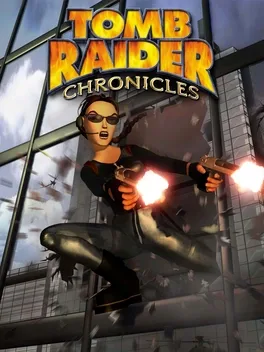
Tomb Raider: Chronicles
Introduction
Released in the late year 2000, Tomb Raider: Chronicles (also recognized by fans as TRC or TR5) represents a unique chapter in the long-running action-adventure franchise. Developed by Core Design and published by Eidos Interactive, it was the fifth installment to utilize the original game engine. Following the dramatic conclusion of the previous game, where Lara Croft was left buried under the collapsed Temple of Horus, this sequel takes a retrospective approach. Instead of a linear forward-moving plot, Tomb Raider 5: Chronicles serves as an anthology of previously untold stories from Lara's life. It captures the essence of the classic era while pushing the aging hardware to its absolute limits before the series transitioned to next-generation consoles.
Story & Setting
The narrative framework is framed by a gathering of Lara's closest friends at the Croft Manor. Characters such as Winston the butler and Father Patrick meet on a rainy afternoon to share memories of the legendary explorer's past exploits. This narrative device allows the game to jump between four distinct and diverse settings across the globe. Players explore the cobblestone streets and opera houses of Rome, a high-tech corporate skyscraper, a hauntingly supernatural island in Ireland, and a claustrophobic Russian nuclear submarine. This international flavor led to various localizations, such as Tomb Raider: Die Chronik in Germany and Tomb Raider: Хроники in Russia. Each chapter offers a different atmosphere, ranging from traditional archaeology to modern stealth-based espionage.
Gameplay
Mechanically, the game remains faithful to the grid-based movement and puzzle-heavy structure that defined the series. However, Core Design introduced several new skills to expand Lara's repertoire. For the first time, Lara can walk across tightropes, swing on horizontal bars, and execute a forward somersault from a ledge while crouching. Her inventory also expanded with the inclusion of a grappling hook gun, which added new vertical layers to level design. In Italy, the game is known as Tomb Raider Chronicles: La leggenda di Lara Croft, and players in Asia knew it as 古墓奇兵5:回憶錄 or 古墓丽影:历代记. A significant addition for the PC version was the inclusion of the Tomb Raider Level Editor, which allowed the dedicated fan community to design their own stages using the same tools as the professional developers.
This game was released on several platforms, including the original PlayStation and the Sega Dreamcast, providing varied graphical fidelity across different versions.
Legacy
While Tomb Raider V faced criticism at the time for its aging engine and the perceived "Tomb Raider fatigue," its legacy has endured through its clever level design and storytelling. In France, the title Tomb Raider : Sur les traces de Lara Croft emphasizes the hunt for her legacy. It remains a polarizing yet essential piece of the series' history, serving as a farewell to the 32-bit era. The anthology format provided a much-needed breath of fresh air by showing different facets of Lara's personality, from her youthful curiosity on the Black Isle to her professional expertise in the high-stakes VCI building heist.
Fun Facts
- The Irish levels feature a teenage Lara Croft who has no weapons, forcing players to rely purely on environmental awareness and stealth to avoid supernatural threats.
- The stealth mechanics in the VCI levels were heavily influenced by the popularity of the stealth-action genre at the time, introducing a headset for communication.
- Many assets and sound effects from this game were repurposed by the fan-modding community to create thousands of custom levels that are still played today.
- The game ends with a teaser that Lara’s backpack was found in Egypt, confirming to fans that the world's most famous tomb raider had indeed survived her ordeal.