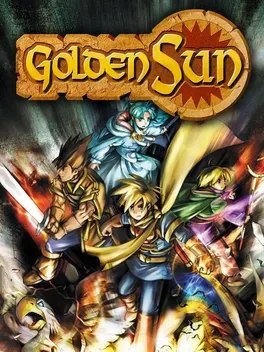
Golden Sun
Introduction
When the Game Boy Advance launched, players were hungry for an experience that could mirror the depth and graphical fidelity of home console RPGs. In 2001, Camelot Software Planning delivered exactly that with Golden Sun. Known in its native Japan as Ougon no Taiyou, this title quickly became a benchmark for handheld gaming. It wasn't just a portable distraction; it was a sweeping epic that pushed the hardware to its absolute limits, featuring pseudo-3D graphics, a soaring orchestral score, and a complex narrative. Whether you know it as the original release or by the title Golden Sun: The Broken Seal (often used to distinguish it from its direct sequel), its impact on the genre remains undeniable even decades later.
Story & Setting
The game is set in the vast world of Weyard, a land where the ancient power of Alchemy was once a common tool for creation. However, fearing the destructive potential of this power, the ancients sealed Alchemy away using four Elemental Stars. The story begins in the village of Vale, situated at the foot of Mount Aleph, where the seal is kept. Years after a tragic accident, the protagonist Isaac and his friends Garet, Ivan, and Mia must set out to stop a group of antagonists—Saturos and Menardi—who seek to light the four Elemental Lighthouses and unleash Alchemy back into the world. The narrative is often referred to by the more descriptive title Ougon no Taiyou: Hirakareshi Fuuin, which translates to "The Broken Seal," highlighting the central conflict of the seals being compromised. As darkness begins to cover the world, the fate of mankind hangs in the balance, requiring the heroes to master their internal power to prevent a global catastrophe.
Gameplay
At its core, Golden Sun is a traditional turn-based role-playing game, but it introduces several innovative layers. The most significant is the Djinn system. Throughout Weyard, players discover elemental creatures called Djinn—representing Earth (Venus), Fire (Mars), Wind (Jupiter), and Water (Mercury). These creatures can be "Set" to characters to boost stats and change their character classes, or they can be "Standby" to perform powerful summons. This creates a deep strategic layer where players must decide between the passive stat bonuses of the Djinn or the immediate, devastating power of a summon like Judgment or Boreas.
Beyond combat, the game utilizes "Psynergy"—the game's version of magic—for intricate environmental puzzles. Unlike most RPGs where magic is reserved for battle, players in Golden Sun must use spells like Move, Growth, and Whirlwind to manipulate the environment, solve riddles, and navigate complex dungeons. This integration of magic into the world-building makes exploration feel rewarding and interactive.
This game was originally released for the Game Boy Advance and later made its way to the Wii U via the Virtual Console service, allowing a new generation to experience the journey on a larger screen.
Legacy
Golden Sun is frequently cited as one of the best games ever made for the Game Boy Advance. Its success spawned two sequels: The Lost Age and Dark Dawn. Beyond the sales numbers, its legacy lives on through its incredible soundtrack composed by Motoi Sakuraba and its influence on modern indie RPGs. Fans have spent years campaigning for the series' return, particularly through the "Operation Sunrise" movement, and the inclusion of Isaac as an Assist Trophy in the Super Smash Bros. series serves as a testament to the character's enduring popularity. It proved that a handheld device could deliver a narrative and technical experience as rich as any 32-bit or 64-bit console.
Fun Facts
- The game was originally intended to be a single massive title for the Nintendo 64, but development shifted to the GBA, and the story was eventually split into two parts due to hardware storage limitations.
- In Chinese-speaking regions, the game is widely known as 黄金太阳 (Huángjīn Tàiyáng).
- The game features a unique "password" or Link Cable transfer system that allows players to carry over their stats, items, and Djinn to the sequel, Golden Sun: The Lost Age.
- The character designs were created by Shin Hashimoto, who aimed for a distinct look that would stand out on the GBA's small, unlit screen.