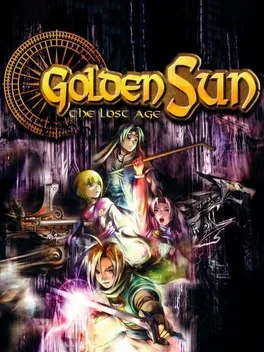
Golden Sun: The Lost Age

Golden Sun: The Lost Age\n\n- Introduction\n- Story & Setting\n- Gameplay\n- Platforms\n- Legacy\n- Fun Facts\n\n## Introduction\n\nReleased in 2002, Golden Sun: The Lost Age is the monumental second installment in the Golden Sun series developed by Camelot Software Planning. Often referred to by fans simply as Golden Sun 2, this title serves as a direct continuation of the first game's narrative, effectively completing the saga that began on the Game Boy Advance. It remains one of the most technically impressive role-playing games of its generation, pushing the handheld's hardware to its absolute limits with pseudo-3D graphics and a sweeping orchestral score. Whether known as Ougon no Taiyou: Ushinawareshi Toki in Japan or by its regional titles across Europe, the game represents a golden era of JRPGs where intricate storytelling and deep mechanical systems merged seamlessly to create an unforgettable adventure.\n\n## Story & Setting\n\nThe narrative of Golden Sun: The Lost Age picks up immediately following the climactic events at the Venus Lighthouse. In a bold narrative shift, players take control of Felix and his companions—Jenna, Sheba, and the scholar Kraden—who were the "antagonists" or secondary characters in the previous game. This perspective change allows players to see the quest for Alchemy through a different lens. While the previous heroes sought to prevent the release of Alchemy to save the world from potential destruction, Felix’s party believes that lighting the remaining two elemental lighthouses is necessary to prevent the world of Weyard from physically eroding away. This duality of purpose creates a compelling moral tension throughout the journey. In Spain, the game was released as Golden Sun II: La Edad Perdida, highlighting the "lost age" that Felix hopes to reclaim. The journey spans the vast Eastern Sea and the hidden continent of Indra, eventually leading to the frozen reaches of Prox as the party tries to determine if restoring Alchemy will bring salvation or total annihilation.\n\n## Gameplay\n\nGameplay in Golden Sun: The Lost Age retains the robust turn-based combat and puzzle-heavy exploration that defined its predecessor. The signature Djinn system returns, allowing players to collect elemental spirits that can be equipped to alter character classes, stats, and abilities. Players can mix and match Djinn to discover powerful "Summons" that deal massive damage to foes. A standout feature is the Psynergy system, which uses magic for both combat and environmental interaction. Players must use spells like "Move," "Lash," and "Parch" to solve complex dungeon puzzles. For those who played the original game, a unique "Transfer System" allows players to migrate their data via a Link Cable or a lengthy password, ensuring their levels, items, and Djinn carry over for a final confrontation. Additionally, the game features a dedicated LAN PVP mode via GBA Game Link Cable, allowing players to battle their friends' custom-built teams in an arena setting, a feature highly praised by the community under the name Golden Sun 2.\n\n## Platforms\n\nThis title has been made available on a few different systems since its initial launch on the Game Boy Advance.\n\n \n\n## Legacy\n\nThe legacy of the Golden Sun series is cemented by its incredible production values and deep lore. In France, where it is known as Golden Sun: L'Âge perdu, and in Italy, titled Golden Sun: L'era Perduta, the game received universal acclaim for its visual style and the compositions of Motoi Sakuraba. It is frequently cited in "Best GBA Games of All Time" lists and is remembered for its ambitious scope, which was originally intended to be part of a single massive game alongside the first title. The decision to split them resulted in two of the most polished RPG experiences on the platform. Even decades later, the fan base remains vocal, hoping for a revival of the franchise that successfully balanced traditional JRPG tropes with innovative environmental puzzling.\n\n## Fun Facts\n\nOne of the most interesting aspects of the game’s development is that Golden Sun: The Lost Age was originally meant to be the second half of a single game. Due to storage limitations on GBA cartridges at the time, Camelot had to split the story into two parts. The game's LAN PVP mode via GBA Game Link Cable was a rarity for handheld RPGs, providing a competitive edge to the collection of Djinn. Another fun fact is that if players do not transfer their data from the first game, the original heroes will still join the party later in the story, but with a set of default stats and equipment. Finally, the "Golden Sun" itself refers to the ultimate power released when all four lighthouses are lit, a visual spectacle that remains a highlight of the series' 16-bit-style graphics.

Found 5 item(s) for sale

  • Golden Sun: The Lost Age

    Seller: retrogameplace

    Country of origin: Spain

    Status: loose

    Description:

    Uploaded Photo
    Image of
  • Golden Sun: The Lost Age

    Seller: retrogameplace

    Country of origin: Spain

    Status: loose

    Description:

    Uploaded Photo
    Image of
  • Golden Sun: The Lost Age

    Seller: retrogameplace

    Country of origin: Spain

    Status: loose

    Description:

    Uploaded Photo
    Image of
  • Golden Sun: The Lost Age

    Seller: retrogameplace

    Country of origin: Spain

    Status: loose

    Description:

    Uploaded Photo
    Image of
  • Golden Sun: The Lost Age

    Seller: retrogameplace

    Country of origin: Spain

    Status: loose

    Description:

    Uploaded Photo
    Image of