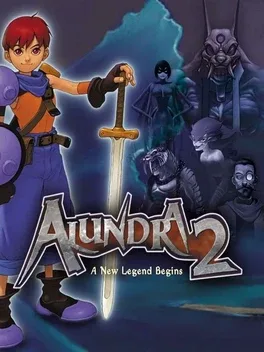
Alundra 2: A New Legend Begins
Table of Contents
Introduction
Alundra 2: A New Legend Begins, released at the turn of the millennium, represents a daring and experimental era for the PlayStation. While its predecessor was a dark, 2D sprite-based epic, this sequel took a radical leap into the third dimension. Often searched for by its regional variation or common misspelling, Alunda 2, the game sought to establish a new identity for the franchise. Developed by Matrix Software, it exchanged the somber, dream-walking themes of the original for a more colorful, swashbuckling adventure filled with humor, mechanical oddities, and some of the most challenging puzzles of its generation. It remains a fascinating snapshot of the late-90s transition from 2D mastery to 3D exploration.
Story & Setting
The narrative follows Flint, a renegade swordsman with a heavy past. Flint is a wanted man, hunted for his perceived crimes while he secretly pursues the pirates who tore his family apart. His journey brings him to the vibrant Kingdom of Varuna, a land caught in the grip of the sinister Baron Diaz. The story is a dense and intricate tale populated by a cast of bizarre characters, including a bumbling pirate trio and the determined Princess Alexia. As Flint navigates through hidden dangers, the plot shifts from a political coup to a much darker supernatural threat. It is eventually revealed that an even greater evil, the sorcerer Mephisto, is using clockwork technology to turn living creatures into mindless mechanical puppets. Flint must rise above his status as a fugitive to prevent the total mechanization of his world.
Gameplay
Gameplay in Alundra 2 is a blend of high-speed combat, platforming, and complex logic puzzles. Moving away from the top-down view, the game employs a rotatable 3D camera that is crucial for navigating its intricate environments. As Flint, players must master weapon wielding to take down a variety of mechanical and organic foes. The game is famous—and sometimes infamous—for its brain-twisting puzzles that require keen observation and precise timing. To aid in his quest, Flint can collect elemental rings that grant him magical powers, which are as vital for solving environmental riddles as they are for defeating bosses. Between the heavy dungeon crawling, players can engage in "wild games," a series of diverse mini-games that offer a break from the main story while providing valuable rewards for Flint's character progression.
This game was released on the PlayStation console, seeing distribution across the NTSC-U, NTSC-J, and PAL regions.
Legacy
The legacy of Alundra 2 is one of significant transformation. For many years, it was a polarizing title because it shifted so far from the tone and aesthetic of the first game. However, in the decades since its release, it has been re-evaluated as a high-quality Action-RPG in its own right. It is praised for its ambitious scope, quirky writing, and the sheer variety of its gameplay mechanics. While it didn't spark a long-running franchise, it stands as a testament to the creativity of the original PlayStation era, where developers weren't afraid to completely reinvent a series' formula. For fans of challenging retro adventures, it remains a must-play cult classic.
Fun Facts
Despite the number in the title, Alundra 2: A New Legend Begins is not a direct sequel to the original game; it features an entirely new world, separate lore, and a different protagonist. Interestingly, the name Alunda 2 often appears in secondary markets due to a common typo in early promotional materials or fan translations. Another unique aspect is the game’s pervasive mechanical theme, which was inspired by the burgeoning steampunk trend of the late 90s, blending traditional fantasy with gears, cogs, and clockwork technology.