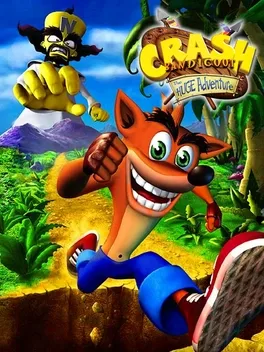
Crash Bandicoot: The Huge Adventure
Introduction
When Sony’s former mascot made the leap from the PlayStation to handheld devices, fans were skeptical. Could the orange marsupial’s chaotic energy translate to a smaller screen? Released in 2002, Crash Bandicoot: The Huge Adventure (known in Europe and Japan as Crash Bandicoot Advance) proved that size does not always matter. Developed by Vicarious Visions, this title brought the beloved platforming formula to the Game Boy Advance, ensuring that fans could spin-attack their way through levels while on the go. It successfully captured the aesthetic and mechanics of the original trilogy while introducing new elements tailored for a portable experience.
Story & Setting
The narrative kicks off with Dr. Neo Cortex, the series' perennial antagonist, reaching a new level of frustration. Tired of his constant defeats at the hands of the bandicoots, he utilizes a massive Planetary Minimizer to shrink the entire Earth to the size of a wumpa fruit. The once-mighty planet is now a tiny sphere, leaving Crash and Coco in a precarious position. To rectify this global catastrophe, Coco Bandicoot constructs a machine capable of reversing the shrinking effect. However, the device requires the energy of Power Crystals scattered across the world. The setting spans several diverse environments, including lush jungles, frozen tundras, and high-tech laboratories, all rendered beautifully on the GBA hardware.
Gameplay
Crash Bandicoot: The Huge Adventure stays remarkably faithful to the core mechanics established in the PlayStation era. The gameplay is primarily a side-scrolling platformer, but it cleverly integrates multiple perspectives to keep the action fresh. Players will navigate through over 20 massive levels across six unique locations, engaging in traditional platforming where timing and precision are key. In addition to the standard levels, the game features exhilarating 3D chase sequences where Crash must run toward the camera to escape looming threats. Furthermore, the inclusion of aerial dogfight combat sequences adds a layer of variety, allowing players to take to the skies. To achieve 100% completion, players must not only collect crystals but also find hidden gems and beat time trials, maintaining the high replayability the series is known for. The controls are tight and responsive, mirroring the physics of the original games despite the change in dimensions.
This title was specifically designed to leverage the power of Nintendo's handheld hardware, offering a console-quality experience in a pocket-sized format.
Legacy
The legacy of The Huge Adventure is significant as it marked the beginning of a long relationship between Vicarious Visions and the Crash Bandicoot franchise. It was the first time a Crash game appeared on a Nintendo platform, a moment that heralded the series' transition into a multi-platform powerhouse. Critics praised the game for its impressive graphics, which managed to mimic the 3D look of the console games using 2D sprites and pre-rendered backgrounds. It set a high bar for what a mascot platformer could achieve on the Game Boy Advance, leading to several sequels on the platform, including N-Tranced. Decades later, it is remembered as one of the best platformers on the system.
Fun Facts
- The game is often referred to by its PAL title, Crash Bandicoot Advance, particularly in European regions.
- Despite the shrunken Earth plot, the levels are ironically some of the most expansive seen in a handheld platformer at the time.
- This was the first game in the series not developed by Naughty Dog or Traveller's Tales, proving that other studios could handle the IP successfully.
- The boss fights feature classic villains like Dingodile and Tiny Tiger, reimagined for the handheld screen.
- The game features a secret ending if the player manages to collect every single gem and crystal, providing extra incentive for completionists.