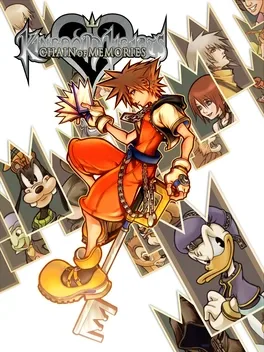
Kingdom Hearts: Chain of Memories

Kingdom Hearts: Chain of Memories\n\n Introduction\n Story & Setting\n Gameplay\n Platforms\n Legacy\n Fun Facts\n\n## Introduction\n\nKingdom Hearts: Chain of Memories stands as a pivotal and experimental chapter in the beloved crossover franchise that combines the magic of Disney with the storytelling depth of Square Enix. Released in late 2004, this title served as the first direct sequel to the original Kingdom Hearts, bridging the narrative gap between the first game and Kingdom Hearts II. Developed by Jupiter and published by Square Enix, it offered a unique departure from the series' established real-time action-RPG mechanics, opting instead for a strategic card-based system. Often referred to simply as Chain of Memories by the community, the game proved that the franchise could thrive on handheld devices while delivering a plot that is absolutely essential to understanding the series' complex overarching lore. By taking the adventure to the Game Boy Advance, the developers managed to translate a grand 3D epic into a beautiful 2D isometric experience that remains a fan favorite for its distinct charm and challenging mechanics.\n\n## Story & Setting\n\nThe story begins exactly where the first game left off. Sora, along with his loyal companions Donald Duck and Goofy, travels down a long, winding path in search of King Mickey and Riku. Their journey leads them to the mysterious Castle Oblivion. Upon entering, they encounter a hooded figure who explains that the castle causes visitors to lose their memories in exchange for uncovering new ones. As Sora ascends the castle's floors, he begins to forget his past friends and adventures, while new, fabricated memories of a girl named Namine begin to take hold. Chronologically, this is the third game in the timeline, following Kingdom Hearts Birth by Sleep and the original Kingdom Hearts, and its events occur simultaneously with Kingdom Hearts 358/2 Days. The narrative is split into two parts: \"Sora's Tale,\" where he battles the enigmatic Organization XIII, and \"Reverse/Rebirth,\" a secondary campaign unlocked after completion that follows Riku as he struggles with the darkness in his heart within the castle's basement levels.\n\n## Gameplay\n\nThe gameplay of Kingdom Hearts: Chain of Memories is built entirely around a deck-building mechanic. In this system, every action—including physical attacks, magic spells, item usage, and summonings—is represented by a card with a value from 0 to 9. Combat occurs in real-time, but players must manage their hand of cards to successfully land hits. If two cards are played at once, the higher value wins, resulting in a \"Card Break\" that cancels the opponent's move. Cards with a value of 0 are particularly strategic; they can break any card regardless of value if played second, but are easily broken themselves if played first. Players can also combine three cards to perform \"Sleights,\" which are powerful special abilities or magic chains. Outside of combat, exploration is also card-based. To progress through Castle Oblivion, players use \"Map Cards\" to synthesize rooms. These cards dictate the properties of the next room, such as the number of enemies, the presence of a save point, or the likelihood of finding rare treasures, giving players significant control over their progression.\n\n## Platforms\n\nThis game was originally released as a dedicated handheld title, specifically designed to push the graphical and processing limits of the Game Boy Advance hardware.\n\n \n\n## Legacy\n\nThe legacy of Kingdom Hearts: Chain of Memories is profound, as it introduced several elements that became core pillars of the franchise. It marked the first appearance of Organization XIII and the concept of Nobodies, elements that would dominate the narrative of Kingdom Hearts II and beyond. While the card-based combat was initially seen as a radical shift, it has been praised for its tactical depth and the way it forced players to think differently about RPG encounters. The game's importance was cemented when Square Enix released a full 3D remake, Kingdom Hearts Re:Chain of Memories, which brought the GBA's story and mechanics into a high-definition environment for home consoles. Even years later, Chain of Memories is remembered as a bold creative risk that successfully expanded the scope of what a handheld spin-off could achieve in terms of both gameplay innovation and narrative weight.\n\n## Fun Facts\n\n Chain of Memories was the very first Kingdom Hearts title to appear on a Nintendo console.\n The developer, Jupiter, is the same studio responsible for the popular Pokémon Pinball and Picross titles.\n The game features impressive full-motion video cutscenes, which were incredibly rare for a Game Boy Advance cartridge due to storage limitations.\n The \"Reverse/Rebirth\" mode introduced in this game was the first time in the series that Riku became a fully playable character with his own unique progression system and story arc.\n* The game's script was written to ensure that players who missed the first game could still understand the stakes, even as the characters themselves were losing their memories.

Found 2 item(s) for sale

  • Kingdom Hearts: Chain of Memories

    Seller: retrogameplace

    Country of origin: Spain

    Status: loose

    Description:

    Uploaded Photo
    Image of
  • Kingdom Hearts: Chain of Memories

    Seller: retrogameplace

    Country of origin: Spain

    Status: loose

    Description:

    Uploaded Photo
    Image of