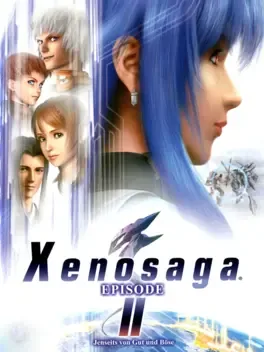
Xenosaga Episode II: Jenseits von Gut und Böse
Introduction
Xenosaga Episode II: Jenseits von Gut und Böse is a monumental science-fiction role-playing game developed by Monolith Soft and published by Namco. Released in 2004, it serves as the middle act of a profound space opera that explores the nature of consciousness, the divine, and the consequences of human ambition. Known also by its Japanese title, Xenosaga Episode II: Zenaku no Higan, or simply as Xenosaga Episode 2: Jenseits von Gut und Böse, the game represents a bold evolution of the series. Throughout its international release, it has been cataloged under various names to accommodate regional spellings, including Xenosaga Episode II: Jenseits von Gut und Bose and Xenosaga Episode II: Jenseits von Gut und Boese. Some fans may also recognize it in database entries as Xenosaga Episode 2: Jenseits von Gut und Boese or Xenosaga Episode 2: Jenseits von Gut und Bose. Regardless of the specific nomenclature used, this entry is a pivotal moment in the Xeno meta-narrative, bridging the gap between the initial discovery of the Zohar and the climactic finale of the trilogy.
Story & Setting
The narrative of Episode II dives deeper into the labyrinthine plot established by its predecessor. The story shifts focus slightly from Shion Uzuki to provide a comprehensive back-story for Jr. (Rubedo) and his twin brother Albedo, two of the "URTV" children created genetically to combat the extraterrestrial threat known as the Gnosis. As the crew of the starship Elsa travels toward the planet Second Miltia, they become embroiled in a conspiracy involving the Zohar, a mysterious and powerful monolith that has shaped human history. The game utilizes "Encephalon dives"—virtual reality explorations of the subconscious—to unravel the psychological trauma of its protagonists. The philosophical underpinnings of the plot are reflected in the subtitle, "Jenseits von Gut und Böse," referencing Friedrich Nietzsche’s challenge to traditional morality. The interplay between Shion Uzuki’s scientific curiosity and the android KOS-MOS’s burgeoning autonomy adds a layer of existential tension that defines the high-concept setting.
Gameplay
The gameplay mechanics of Xenosaga Episode II: Jenseits von Gut und Böse introduced significant changes to the established formula of the first game. The turn-based combat system was refined with the addition of the "Zone" and "Stock" systems. Enemies are divided into hit zones (A, B, and C), and players must hit specific height sequences to "Break" an enemy's defense. Once broken, enemies can be launched into the air or downed, allowing for massive damage through chained attacks. To facilitate these chains, characters can use the "Stock" command to save up turn points. The management of the "Boost" gauge remains critical, allowing players to steal turns from enemies to maintain momentum. Furthermore, the game features grand-scale mech combat using E.S. units, which possess their own unique progression systems and combat animations. Unlike the first game, character growth is managed through a complex skill tree that requires players to spend points earned in battle to unlock new abilities and stat bonuses, providing a deeper level of customization.
Xenosaga Episode II: Jenseits von Gut und Böse was developed specifically for the home console market during the sixth generation of gaming. This game was released on several platforms, including the original PlayStation 2 hardware across all major global regions.
Legacy
The game's legacy is often discussed in the context of its divisive design choices. The transition from a stylized anime aesthetic to more realistic character models was a major point of contention among the fanbase, as was the streamlined inventory system that removed traditional shops. However, the game is widely celebrated for its soundtrack and its unapologetically complex story. The collaboration between Yuki Kajiura, who composed the cutscene music, and Shinji Hosoe, who handled the gameplay tracks, created a unique auditory identity. The game laid the groundwork for the epic conclusion in Episode III and established Monolith Soft as a studio capable of weaving intricate, multi-game narratives. These storytelling techniques and world-building ambitions would eventually lead to the massive success of the Xenoblade Chronicles series on Nintendo platforms.
Fun Facts
One of the most interesting facts about the game's release is that the PAL version came with a "Special Movie" DVD. Since Xenosaga Episode I was never officially released in Europe, this DVD contained a three-hour compilation of all the first game's cutscenes to ensure new players understood the plot. Another trivia point is the title's German origin; "Jenseits von Gut und Böse" translates to "Beyond Good and Evil," a direct nod to the works of Friedrich Nietzsche, whose philosophy permeates the entire Xenosaga trilogy. Additionally, the character designs were subtly altered between the Japanese and Western versions to comply with different regional rating standards regarding the game’s more intense psychological sequences and depictions of conflict.