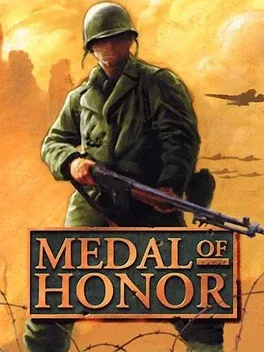
Medal of Honor
Introduction
Before the market became saturated with World War II shooters, one title stood as the definitive cinematic experience for home consoles. Released in 1999, Medal of Honor—often referred to by fans as MoH or moh—redefined the first-person shooter genre on the original PlayStation. Conceived by the legendary filmmaker Steven Spielberg, the game brought a level of gravitas and historical immersion that was previously unseen in the medium. It was not just about pulling a trigger; it was about participating in a grand historical narrative. Spielberg's vision was to create a game that felt like a movie, ensuring that every mission carried weight and every environment felt dangerous and authentic. This approach transformed how developers viewed storytelling in the FPS space.
Story & Setting
The narrative centers on Jimmy Patterson, a 24-year-old OSS operative with a background as a C-47 transport pilot. Set during the final days of World War II, the game follows Patterson as he is recruited into the Office of Strategic Services. His missions are varied and high-stakes, as he infiltrates and sabotages the Nazi War Machine from within. The game takes players across a variety of European locales, each meticulously designed to reflect the era's atmosphere. Known in different regions by names like 荣誉勋章 and Медаль за Отвагу, the story of Patterson's heroism resonated globally, portraying the clandestine side of the war where individual actions changed the course of history. From snowy peaks to hidden salt mines, the setting provides a somber backdrop to the intense action.
Gameplay
The gameplay mechanics of Medal of Honor were revolutionary for console hardware at the turn of the century. While many shooters of the era were arcade-like and focused on high-speed movement, MoH introduced a more methodical, mission-based structure. Players were required to complete specific objectives to finish a level, such as finding secret documents, destroying anti-aircraft guns, or impersonating German officers. The game featured a sophisticated hit-detection system where enemies would react differently depending on where they were shot—dropping weapons if hit in the arm or losing helmets if hit in the head. This level of detail, combined with the need for occasional stealth and disguise, made the gameplay feel more like a simulation of an operative's life than a typical shooter. The balance between intense firefights and quiet infiltration set a new bar for the genre.
Medal of Honor was originally developed to push the technical limits of the PlayStation, and it was later made available to a wider audience through digital distribution on newer systems.
Legacy
The legacy of Medal of Honor is immense, as it essentially paved the way for the modern military shooter. Many of the developers who worked on this title and its immediate sequels went on to form Infinity Ward and create the Call of Duty series. It proved that first-person shooters could be successful on consoles, a feat many thought difficult before the advent of dual-analog controls. The game’s focus on historical accuracy, combined with its cinematic presentation, influenced countless titles that followed in its footsteps. Critics at the time praised its "unprecedented" realism and its hauntingly beautiful orchestral score, solidifying its place in the pantheon of gaming classics. Even today, the name MoH is remembered as the gold standard for historical storytelling in interactive media.
Fun Facts
There are several fascinating tidbits surrounding the development of this classic. Steven Spielberg’s interest in the project was sparked while he was supervising the post-production of his film, 'Saving Private Ryan.' He wanted to create a tool that could teach younger generations about the sacrifices made during the war through an interactive medium. Another interesting fact is that the game's score was composed by Michael Giacchino, who would later become a world-renowned film composer, winning an Oscar for his work on Pixar's 'Up.' To ensure the highest level of authenticity, the development team consulted with Captain Dale Dye, a military veteran who also served as a consultant on Spielberg's films. This commitment to realism extended to the audio, with many sound effects being recorded from actual WWII weapons and equipment to maintain maximum historical accuracy.