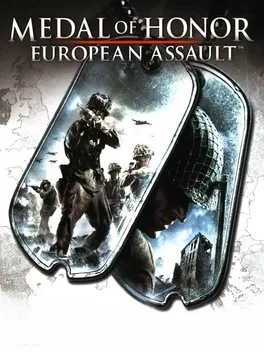
Medal of Honor: European Assault
Table of Contents
Introduction
The Medal of Honor series has always been a cornerstone of the World War II first-person shooter genre, but few entries offered the tactical flexibility found in Medal of Honor: European Assault. Released in 2005, this title sought to break the mold of the highly scripted "corridor shooters" that defined the era. Known during development as Medal of Honor: Dogs of War—and released in French-speaking territories as Medal of Honor : Les faucons de guerre—it introduced a sense of scale and agency that was revolutionary for the franchise at the time. Stepping into the boots of a specialized operative, players were no longer just cogs in a machine; they were the catalysts for victory across the most pivotal theaters of the war.
Story & Setting
The narrative follows Lieutenant William Holt, an officer of the newly formed Office of Strategic Services (OSS). Unlike previous protagonists who were often standard soldiers caught in extraordinary circumstances, Holt is a specialist sent where the fighting is fiercest. The campaign is divided into four massive geographical areas: France, North Africa, the Soviet Union, and Belgium.
The story begins with the daring St. Nazaire Raid in France and eventually moves through the scorching deserts of North Africa and the frozen ruins of Stalingrad, culminating in the Battle of the Bulge in Belgium. Throughout these campaigns, Holt is tasked with uncovering a secret Nazi plot involving nuclear research, led by the primary antagonist, Graf Von Schrader. The globe-trotting nature of the setting provides a comprehensive look at the European and African theaters, blending historical accuracy with high-stakes espionage and covert operations.
Gameplay
The core of Medal of Honor: European Assault lies in its open-ended mission design. While previous games were largely linear, European Assault provides players with expansive maps where exploration is rewarded. Each mission is built upon five distinct elements: completing a primary objective, achieving secondary goals, engaging in a "Nemesis" battle against a high-ranking German officer, stealing intelligence documents from that officer, and successfully extracting from the area.
The Nemesis system is a highlight, featuring unique mini-bosses—henchmen of Von Schrader—who require tactical thinking to defeat. Performance is graded with medallions; securing a Gold medallion requires the completion of every single task, whereas Silver and Bronze are awarded for partial success. Players are also responsible for a small squad of Allied NPCs. Managing their health with medkits and directing their fire is essential for survival. Furthermore, the "Adrenaline" mechanic allows players to enter a brief state of invincibility and infinite ammo after performing well, providing a much-needed edge during the game's most intense firefights.
This game was released on several platforms, including the Xbox, PlayStation 2, and Nintendo GameCube.
Legacy
Medal of Honor: European Assault is remembered as a transitional pivot for the series. It moved the franchise toward a more "hero-centric" narrative and introduced non-linear level design that would influence later titles like Medal of Honor: Airborne. Critics at the time praised its orchestral score and the tension of its Nemesis encounters, though some noted the high difficulty curve and the lack of mid-mission checkpoints. Despite these challenges, it remains a fan favorite for its atmosphere and the way it successfully integrated squad-based tactics into a fast-paced arcade shooter framework.
Fun Facts
- The game's script was penned by John Milius, the legendary screenwriter behind Apocalypse Now and the director of Red Dawn.
- The powerful soundtrack was composed by Christopher Lennertz, who won an AIAS award for his work on the game, which was recorded with a full orchestra at Abbey Road Studios.
- Although the working title Dogs of War was dropped for the North American release, it was retained as the subtitle in some promotional materials and international versions.
- This was the first game in the series where players could choose the order in which they tackled certain objectives within a level, rather than following a strict path.