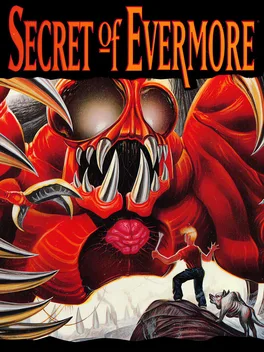
Secret of Evermore
Introduction
In the mid-1990s, Square was the undisputed king of the Japanese RPG, delivering masterpieces like Final Fantasy VI and Chrono Trigger. However, in 1995, the company took a daring leap by tasking its newly formed North American branch in Redmond, Washington, with creating an original title specifically for the Western market. The result was Secret of Evermore, a unique and atmospheric action-RPG that stood apart from its Eastern cousins. Often referred to by the community as SOE, the game combined the polished mechanics Square was known for with a distinctly Western sense of humor, pop-culture references, and a groundbreaking ambient soundtrack.
Story & Setting
The adventure begins in the quiet town of Podunk, USA, in 1995. A young boy and his loyal dog are leaving a movie theater when a stray cat leads them into the abandoned laboratory of the mysterious Professor Ruffleberg. Through a series of accidental events, the pair is transported to the world of Evermore—a dreamlike reality created by the Professor and three other citizens of Podunk.
Evermore is divided into four distinct realms, each based on a different period of human history or imagination. The journey starts in Prehistoria, a land of dinosaurs and volcanos, before moving to Antiqua, which draws heavy inspiration from Roman and Egyptian civilizations. From there, players explore the medieval, plague-ridden castles of Gothica before finally reaching the futuristic space station of Omnitopia. The narrative focuses on the boy’s attempt to find the missing Podunk citizens and solve the mystery of why Evermore has become so dangerous, all while trying to find a way back home.
Gameplay
If you have played Secret of Mana, the gameplay of SOE will feel immediately familiar. It utilizes a real-time combat system with a "stamina bar" that dictates how much damage your physical attacks do; swinging wildly results in weak hits, while waiting for the bar to reach 100% ensures a full-strength strike. The game also retains the iconic "Ring Menu" system, allowing players to cycle through items, spells, and equipment without leaving the action.
However, Secret of Evermore introduces a unique twist: the Alchemy system. Instead of traditional MP (Magic Points), players must find and combine various ingredients—such as wax, limestone, ash, and dry ice—to cast spells. Finding rare formulas and managing your inventory of components adds a strategic layer to the combat. Furthermore, your dog is a playable companion who changes his physical form to match each era (becoming a wolf-like beast in Prehistoria or a robotic toaster-hound in Omnitopia). The dog is invaluable for combat and for sniffing out hidden alchemy ingredients buried in the ground.
This game was primarily released as a flagship title for Nintendo's 16-bit powerhouse, enjoying a dedicated release in North America and the PAL regions.
- SUPER NINTENDO ENTERTAINMENT SYSTEM: PAL, NTSC-U
Legacy
For years, Secret of Evermore lived in the shadow of the rumor that it was developed instead of a Western release for Seiken Densetsu 3 (the sequel to Secret of Mana). While this has been debunked—the two projects were handled by entirely different teams—it shaped the game's early reception. Over time, however, the gaming community has grown to appreciate the title for its own merits.
Its legacy is most strongly felt in its audio design. This was the first major project for composer Jeremy Soule, who would go on to create the iconic scores for The Elder Scrolls series. His work here was revolutionary, opting for ambient environmental sounds, wind, and subtle melodies rather than the traditional upbeat JRPG tunes of the era. Today, it is remembered as a bold experiment that proved Western developers could capture the "Square magic."
Fun Facts
- Young Talent: Jeremy Soule was only 19 years old when he was hired to compose the game’s soundtrack.
- Movie Buff: Throughout the game, the protagonist constantly quotes fictional B-movies he saw in Podunk, which serves as a running gag and a commentary on 1950s-90s cinema.
- The Dog's Evolution: The dog's form in the futuristic Omnitopia era is capable of firing laser beams from its mouth.
- Secret Cameos: In the Colosseum of Antiqua, eagle-eyed players can spot several famous Final Fantasy VI characters in the audience, including Terra, Locke, Mog, and Relm.