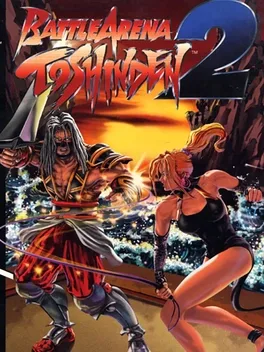
Battle Arena Toshinden 2
Introduction
Story & Setting
Gameplay
Platforms
Legacy
Fun Facts
Introduction
The mid-1990s represented a golden age for fighting games as the industry transitioned from 2D sprites to the uncharted territory of 3D polygons. Among the pioneers was the original Battle Arena Toshinden, a launch title for the Sony PlayStation that showcased the console's power. Its successor, Battle Arena Toshinden 2, arrived in 1995 to build upon that legacy. Developed by Tamsoft and published by Sony and Takara, this sequel refined the mechanics, polished the visuals, and introduced a more aggressive combat system. It stands as a landmark title that helped define the weapons-based 3D fighting sub-genre, offering a high-stakes tournament where steel meets steel and every move counts toward survival.
Story & Setting
The narrative of Battle Arena Toshinden 2 takes place exactly one year after the conclusion of the first tournament. The Secret Society, led by the fallen champion Gaia, was initially defeated, but the organization’s shadow remains long. A new and even more ruthless leader named Uranus has seized control of the Gerard Foundation, the front for the Society. She has organized a second tournament to lure the world's strongest warriors into a trap, intending to harvest their fighting data or eliminate them entirely. Players follow the journeys of diverse combatants, each with personal vendettas or professional duties. Whether it is Eiji seeking his missing brother or Sho pursuing ultimate mastery, the stakes have never been higher in this death-defying secret competition.
Gameplay
The gameplay of Battle Arena Toshinden 2 is characterized by its fluid 3D movement and strategic weapon use. Unlike many of its contemporaries, the game emphasizes the ability to sidestep into the foreground or background, allowing players to dodge vertical strikes and reposition themselves for counterattacks. The control scheme utilizes four main attack buttons—two for slashes and two for kicks—along with dedicated buttons for the 3D roll. The sequel introduced the Overdrive gauge, which fills as players take damage or perform attacks. Once full, players can unleash a devastating Secret Move that can turn the tide of a losing battle. The roster features iconic characters like Sofia with her whip and Mondo with his spear, plus newcomers like Tracy and the mysterious Vermilion. The inclusion of Ring Outs adds another layer of strategy, forcing players to be mindful of their positioning near the edge of the floating arenas.
This game was released on several platforms, including the PlayStation and later saw specialized releases for the Sega Saturn and PC.
Legacy
The legacy of Battle Arena Toshinden 2 is one of innovation and historical importance. At the time of its release, it was considered a visual marvel, pushing hardware to its limits with smooth animations and vibrant particle effects. While it would eventually be eclipsed in popularity by the Tekken and SoulCalibur franchises, it remains a beloved cult classic that proved weapons-based combat had a place in the 3D fighting world. It influenced a generation of developers to experiment with multi-directional movement and environmental hazards. Today, it is remembered fondly by retro gaming enthusiasts as a quintessential 90s arcade-style experience that captured the excitement of the early 3D era.
Fun Facts
- In Japan, a modified version of the game was released for the Sega Saturn under the title Toshinden URA, featuring a slightly different roster and adjusted gameplay balance.
- The character Vermilion is notable for being one of the first characters in a weapon-based fighter to use a handgun, a move that surprised many traditionalists in the fighting game community.
- The game’s soundtrack, composed by Yuji Kikuchi, is frequently cited as one of the best of the era, blending hard rock riffs with synth-pop melodies.
- Despite being a 3D fighter, the character designs were heavily influenced by 90s anime aesthetics, which led to a spin-off anime OVA series.
- Battle Arena Toshinden 2 was one of the first games to utilize the PlayStation's high-resolution mode for certain menu screens and UI elements, making it look much sharper than its peers.