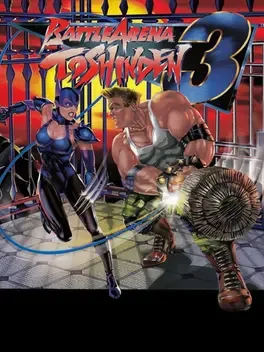
Battle Arena Toshinden 3
Introduction
In the mid-1990s, the fighting game genre was undergoing a radical transformation as it moved from two dimensions into the realm of 3D polygons. Among the pioneers of this era was the Toshinden series, which gained fame as a premier weapon-based fighter on the Sony PlayStation. Battle Arena Toshinden 3, also frequently referred to by fans as Toshinden 3 or simply BAT3, served as the ambitious third chapter in this storied franchise. It aimed to push the hardware of the time to its absolute limits, offering faster combat, a massive roster, and a significant shift in environmental design. Whether you knew it by its Western title or the concatenated data name BAT3Toshinden 3, this entry remains a fascinating snapshot of fighting game history.
Story & Setting
The narrative of Battle Arena Toshinden 3 centers once again on the "Toshinden," a timeless and legendary battle tournament where only the world's most elite fighters are invited. This isn't just a friendly sporting event; it is a brutal struggle for survival where only the strongest emerge unscathed. The plot deepens the mystery of the "Organization," the shadowy group behind the previous tournaments. This time, the stakes are raised as fighters from around the globe find themselves caught in a web of personal vendettas and corporate conspiracies. The game successfully introduces a dual-sided conflict, pitting the classic heroes like Eiji Shinjo and Kayin Amoh against a new group of fighters representing the Organization's sinister interests. The atmospheric arenas reflect this tension, moving from open-air locales to more claustrophobic and dangerous environments.
Gameplay
The core gameplay of BAT3 saw a significant overhaul compared to its predecessors. The most notable change was the move to enclosed arenas. In previous entries, players could win by knocking their opponents out of the ring. However, in this installment, you are caged like an animal in newly designed and closed-in arenas. This allows players to ricochet off walls and ceilings to initiate surprise attacks or find unique ways to retreat from danger. The combat system was refined to support unbelievable smooth gameplay and highly responsive controls, making it the ultimate force to be reckoned with in the genre at the time.
With over 30 characters available—including 12 never-before-seen fighters—the roster was one of the largest on the PlayStation. Each character comes equipped with their own weaponry, fighting style, and lethal move sets. Players can master dozens of new killer moves, complex strategies, and multi-hit combination attacks. For those looking for more than just the arcade experience, the game includes a 2-player mode for head-to-head action, alongside Practice, Survival, and Team Battle modes. A standout technical feature is the ability to choose your performance: players can battle in standard 30 frames per second with enhanced graphics or switch to a blistering 60 frames per second for ultra-fluid motion.
This game was released on several platforms, including the Sony PlayStation across various regions such as PAL, NTSC-J, and NTSC-U.
Legacy
Battle Arena Toshinden 3 holds a unique place in the history of 3D fighters. While it faced stiff competition from series like Tekken and Soul Edge, BAT3 carved out a niche for itself by leaning into its weapon-based mechanics and its high-speed performance options. It is often remembered as the point where the series reached its mechanical peak on the original PlayStation hardware. While the franchise eventually faded from the spotlight, the innovations found in the third entry—particularly the wall-based movement and the massive roster—influenced how developers thought about spatial interaction in 3D fighting spaces. Today, it is a cult classic for those who grew up in the early polygon era.
Fun Facts
- The Western release of the game was actually more feature-rich than the original Japanese release, including the Survival and Team Battle modes which were absent from the initial version.
- Battle Arena Toshinden 3 features one of the most diverse rosters of its time, featuring "sexy, bloodthirsty and deadly characters" ranging from traditional samurai to Victorian-era inspired killers.
- The game allowed a secret toggle to unlock even more hidden characters, eventually pushing the playable cast beyond the initial 30 advertised.
- It was one of the few early 3D fighting games to offer a dedicated 60 frames-per-second mode, a technical achievement that required a slight reduction in graphical detail to maintain speed.