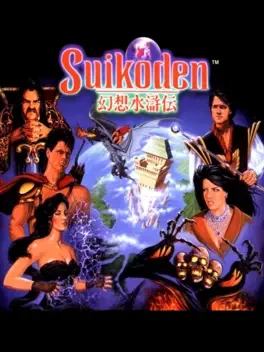
Suikoden
Introduction
Suikoden, originally released in Japan as Gensō Suikoden, stands as a pillar of the 1990s JRPG era. Developed by Konami, it was one of the first major role-playing games to grace the Sony PlayStation, offering a distinct alternative to the high-fantasy tropes of its contemporaries. While many games of the time focused on small bands of heroes fighting cosmic deities, Suikoden grounded its narrative in the complexities of civil war, political betrayal, and the heavy burden of leadership. It is a game that values quantity as much as quality, famously allowing players to recruit a massive cast of characters to join their cause. This recruitment-heavy approach created a unique sense of community within a warring world, ensuring the game's status as a legendary cult classic.
Story & Setting
The narrative of Suikoden is set within the borders of the Scarlet Moon Empire, a land once peaceful but now stifled by the tyranny of its emperor and his corrupt, power-hungry generals. Players step into the shoes of the young son of Teo McDohl, one of the empire's most respected military leaders. The protagonist's life is upended after he obtains the Soul Eater, one of the 27 True Runes governing the world's balance. This Rune, representing the cycle of life and death, is as much a curse as it is a power, as it thrives on the souls of those close to its wielder. Forced into exile, the hero joins a fledgling resistance group known as the Liberation Army. To succeed, the hero must travel across the continent to find and recruit the 108 Stars of Destiny to overthrow the empire. The story is lauded for its emotional maturity, exploring themes of familial duty versus moral righteousness, forcing the player to confront the reality that war has no simple villains.
Gameplay
The gameplay of Suikoden is famously varied, incorporating three distinct systems of conflict that reflect different levels of tactical warfare. The most frequent mode is the traditional turn-based party combat, allowing for deep strategic customization. Players can field an unusually large and versatile party of up to six characters simultaneously. This system is significantly enhanced by the Rune mechanic; instead of a standard mana pool, characters equip specific Runes that allow a set number of spell casts per level, requiring careful management during long and arduous dungeon crawls. Beyond party skirmishes, Strategic Army Battles see the player commanding large units of infantry, archers, and mages. These battles operate on a rock-paper-scissors logic, where Charge beats Bow, Bow beats Magic, and Magic beats Charge. Finally, there are cinematic One-on-One Duels. These high-stakes fights rely on reading the opponent’s dialogue to predict their next move—Attack, Defend, or Desperate Attack—making every turn a tense psychological game. Central to all these systems is the player's headquarters, a castle that grows as more of the 108 Stars of Destiny are recruited.
This game was released on several platforms, including the original PlayStation, the Sega Saturn, and later as a digital classic on handheld and home consoles.
Legacy
The legacy of Suikoden is defined by its innovative approach to storytelling and character collection. While the graphics were sprite-based in an era rapidly moving toward 3D, the artistry and evocative music became iconic. It spawned a long-running series, with Suikoden II often cited as one of the greatest RPGs ever made. The "108 Stars of Destiny" concept became the franchise's trademark, encouraging players to explore every corner of the world to find new allies and build their base. Even decades later, the game's influence can be seen in modern spiritual successors like Eiyuden Chronicle, proving that its blend of political intrigue and recruitment-driven gameplay remains a timeless formula for the genre.
Fun Facts
The concept of the 108 Stars of Destiny is inspired by the 14th-century Chinese classic novel "Water Margin" (Shui Hu Zhuan). While the game is a massive epic, many of the characters are actually "missable," meaning players must follow specific steps or visit areas at specific times to successfully recruit everyone. Additionally, the hero's name is never officially stated in the first game, though in manga and subsequent novelizations, he is often referred to as Tir McDohl. Interestingly, the Sega Saturn version of the game, which was released only in Japan, features several technical enhancements and a slightly different animated intro cinematic compared to the PlayStation original. Despite its grand scope, a skilled player can complete the main story in under twenty hours, making it an accessible classic.