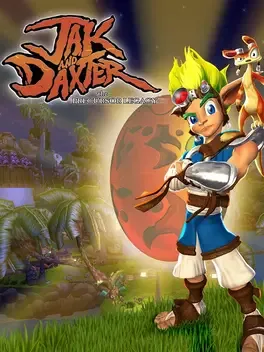
Jak and Daxter: The Precursor Legacy
Introduction
At the dawn of the 128-bit era, a new champion of the platforming genre emerged to showcase the raw power of the PlayStation 2. Developed by the legendary team at Naughty Dog, Jak and Daxter: The Precursor Legacy arrived in 2001 as a technical masterclass. While many players affectionately refer to the game as Jak1 or J&D, its impact on the industry was far more significant than its simple abbreviations suggest. Moving away from the segmented, level-based structure of the 32-bit era, Jak and Daxter: The Precursor Legacy offered a seamless world that felt alive and interconnected, setting a new benchmark for character-driven adventures. Whether known by its English title or as Jak and Daxter: El legado de los Precursores in Spanish-speaking regions, the game remains a vibrant high point in the history of Sony's second home console.
Story & Setting
The narrative unfolds in a world rich with mystery and ancient technology. The story centers on Jak, a silent, athletic teenager, and his boisterous friend Daxter. Ignoring the stern warnings of Samos the Sage, the duo travels to the forbidden Misty Island. In a moment of clumsy curiosity, Daxter falls into a vat of Dark Eco, a dangerous and corruptive substance. Instead of perishing, he is transformed into an "ottsel"—a fictional, fast-talking hybrid of an otter and a weasel. To reverse this transformation, the pair must journey across the world to find Gol Acheron, a Dark Eco Sage, who is the only one rumored to possess the power to change Daxter back. Along the way, they discover that the world is littered with Precursor ruins, remnants of an ancient civilization that left behind powerful artifacts and mysterious machinery that maintain the balance of the ecosystem.
Gameplay
The core of the gameplay experience is a blend of exploration, precise platforming, and combat. Players must collect Power Cells, which act as the primary resource to unlock new areas and progress the story. These are often earned by completing missions or found at the end of challenging platforming sequences. Alongside Power Cells, Jak must gather Precursor Orbs—the game's main currency—to trade with characters, and find Scout Flies hidden in boxes within each zone. The game is famous for its lack of loading screens, allowing Jak to run from the tropical shores of Sandover Village to the snowy heights of the Mountain Pass without interruption. The use of "Eco" provides temporary power-ups: Green Eco heals, Blue Eco increases speed and activates machinery, Red Eco enhances attack power, and Yellow Eco allows Jak to fire energy projectiles. The inclusion of various minigames and vehicle sections, such as piloting the A-Grav Zoomer, ensures that the variety of gameplay experiences remains high throughout the journey.
This title has been a staple of the Sony ecosystem, appearing on multiple generations of hardware since its initial debut.
Legacy
The legacy of this title is defined by its role as a bridge between the mascot-platformers of the 90s and the more cinematic adventures of the 2000s. It established Naughty Dog as a powerhouse developer capable of creating massive, uninterrupted worlds. While the subsequent entries in the series took a significantly darker, more action-oriented turn, the original remains beloved for its bright, whimsical atmosphere and tight controls. It paved the way for modern open-world design, proving that a high-fidelity 3D world could exist without the immersion-breaking interruptions of loading bars. Even decades later, it is frequently cited as one of the greatest platformers of all time, maintaining a dedicated speedrunning community and a permanent spot in the hearts of PlayStation fans.
Fun Facts
Jak and Daxter: The Precursor Legacy was built using a unique programming language called GOAL (Game Oriented Assembly Lisp), which was specifically developed by Naughty Dog founder Andy Gavin. Additionally, Daxter's design was the result of extensive internal testing; developers wanted a sidekick that wasn't just a passive observer but an active, comedic presence. Finally, if you look closely at the Precursor ruins, you can find hidden Naughty Dog logos etched into some of the ancient stone textures, a tradition the studio carried forward from their days working on Crash Bandicoot.