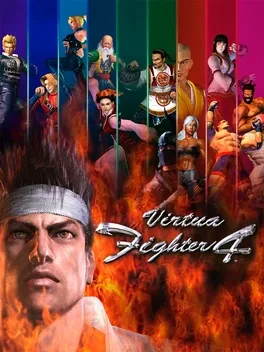
Virtua Fighter 4

Virtua Fighter 4\n\n### Table of Contents\n- Introduction\n- Story & Setting\n- Gameplay\n- Platforms\n- Legacy\n- Fun Facts\n\n## Introduction\nWhen it comes to the technical evolution of the fighting game genre, few titles hold as much weight as Virtua Fighter 4. Developed by the legendary SEGA AM2 and spearheaded by the visionary Yu Suzuki, this 2001 release was more than just a sequel; it was a statement of intent. At a time when the industry was shifting from the dominance of arcades to the power of sixth-generation home consoles, Virtua Fighter 4 arrived to bridge the gap with unparalleled mechanical depth and visual fidelity. As the fourth game in the Virtua Fighter series, it solidified the franchise's reputation as the most disciplined and realistic 3D brawler on the market, demanding a level of precision that few competitors could match. Whether played in the smoky arcade halls of Tokyo or in a living room, it offered a competitive experience that felt truly professional.\n\n## Story & Setting\nThe narrative of Virtua Fighter 4 centers once again on the World Fighting Tournament, a global event organized by the enigmatic and malevolent organization known as J6 (Judgment 6). This shadow syndicate uses the tournament as a front to gather data on the world's most elite combatants, seeking to refine their ultimate biological weapon: the metallic shapeshifter known as Dural. In this fourth installment, the stakes are raised as J6 targets specific fighters for abduction. The tournament serves as the backdrop for personal rivalries and professional quests, with characters like Kage-Maru seeking to save his mother from the clutches of the organization, while others, like the newcomer Lei-Fei, enter with more cryptic and potentially dangerous motivations. The setting is diverse, featuring stages that range from serene snowy peaks to high-tech industrial arenas, all designed to showcase the power of the Naomi 2 hardware.\n\n## Gameplay\nThe gameplay of Virtua Fighter 4 is defined by its rigorous adherence to a three-button system—Punch, Kick, and Guard—which belies an incredible amount of complexity. Unlike its peers that might rely on flashy supernatural moves, this title focuses on weight, timing, and momentum. The introduction of the 'Evade' mechanic allowed for more fluid movement around the 3D space, making positioning more critical than ever before. Two new characters joined the roster: Lei-Fei, a Shaolin monk with various animal stances, and Vanessa Lewis, a Vale Tudo expert with distinct defensive and offensive styles. A significant highlight of the PlayStation 2 version was the 'Quest Mode,' which simulated the experience of an arcade player traveling between different game centers, earning ranks and customizing their character with items. This mode provided hundreds of hours of content, teaching players the intricacies of frame data and counters through practical application rather than dry tutorials.\n\n## Platforms\nThis game was released on several platforms, including the high-powered Naomi 2 arcade board and the PlayStation 2 home console.\n\n \n\n## Legacy\nThe legacy of Virtua Fighter 4 is most prominently seen in its pioneering approach to connectivity. In Japan, Virtua Fighter 4 is famous for spearheading and opening the market for internet functionality in arcades. The launch of VF.NET in 2001 was a watershed moment, allowing players to use IC cards to track their statistics, ranks, and customized character appearances across different arcade locations. This innovation fundamentally changed the arcade landscape in Japan, leading to the creation of the robust networks we see today, such as e-Amusement by Konami, NESiCAxLive by Taito and Square Enix, and ALL.Net by Sega and Bandai Namco. Furthermore, the game's critical reception was stellar, often cited as one of the best fighting games of all time for its balanced roster and deep mechanics that influenced subsequent titles like Tekken 5 and SoulCalibur III.\n\n## Fun Facts\nVirtua Fighter 4 was the first game in the series to include a comprehensive training mode that taught players advanced concepts like 'stagger' and 'tech-rolling.' It also saw two major revisions: 'Virtua Fighter 4: Evolution,' which added characters like Brad Burns and Goh Hinogami, and 'Virtua Fighter 4: Final Tuned,' which refined the balance to near-perfection. Another interesting bit of trivia is that the character Vanessa Lewis was originally designed to be a bodyguard, which is reflected in her tactical and brutal fighting style. Finally, the AI in the home version could be 'trained' by the player, learning their habits and eventually becoming a sparring partner that mirrored the player's own unique combat tendencies."}```

Found 2 item(s) for sale

  • Virtua Fighter 4

    Seller: retrogameplace

    Country of origin: Spain

    Status: loose

    Description:

    Uploaded Photo
    Image of
  • Virtua Fighter 4

    Seller: retrogameplace

    Country of origin: Spain

    Status: loose

    Description:

    Uploaded Photo
    Image of