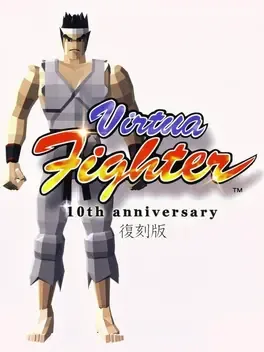
Virtua Fighter 10th Anniversary
Introduction
Virtua Fighter 10th Anniversary is a unique commemorative release that celebrates the first decade of Sega's premier 3D fighting franchise. First introduced to the arcade world in 1993, Virtua Fighter pioneered the use of 3D polygonal graphics in the fighting genre, setting an industry-wide standard for technical excellence. This anniversary edition is far more than a simple re-release; it is a creative experiment that blends the nostalgic, retro aesthetic of the original arcade title with the deep, technical gameplay mechanics of Virtua Fighter 4: Evolution. It serves as a love letter to fans who grew up with the blocky characters of the early nineties but have since come to appreciate the refined, complex combat systems of the modern era.
Story & Setting
The setting of Virtua Fighter 10th Anniversary centers on the World Fighting Tournament, a global competition where the world's most elite martial artists gather to prove their dominance. While the narrative in the series is often subtle, the focus remains on the personal journeys and rivalries of its iconic roster. Legendary fighters like Akira Yuki, the Bajiquan practitioner, and Lau Chan, the master of Koen-ken, return to the arena to test their skills once again. Because this edition includes the expanded roster from the fourth mainline entry, players can witness newer characters like Vanessa Lewis and Brad Burns rendered in the classic, minimalist style of the 1993 tournament, effectively rewriting the history of the early games to include the full modern cast.
Gameplay
The gameplay is a fascinating paradox that defines the title's charm. Visually, the game utilizes the low-polygon, flat-shaded models that were at the cutting edge of technology during the game's initial arcade debut on the Sega Model 1 hardware. However, the internal logic, frame data, and move sets are lifted directly from Virtua Fighter 4: Evolution. This means characters look like they belong in 1993 but fight with the complexity of 2003. The game retains the signature three-button control scheme—Punch, Kick, and Guard—while allowing for advanced techniques like side-stepping, weight-specific combos, and refined grappling. This creates a surreal experience where visual simplicity meets immense mechanical depth, all running at a fluid and consistent sixty frames per second.
This game was released on several platforms, including the PlayStation 2. Its availability varied significantly by region, often bundled with other media as a commemorative package.
Legacy
The legacy of Virtua Fighter 10th Anniversary lies in its status as a significant collector's item and its inventive approach to game preservation. It is widely regarded as a perfect bridge between the genre's infancy and its maturity. In Japan, the title was famously released as part of the "Virtua Fighter 10th Anniversary ~Memory of Decade~" box set, which included an extensive art book and a DVD chronicling the evolution of the series. This release reinforced the idea that fighting games are not just disposable entertainment but a rich part of digital history. It remains a testament to Sega's innovation, demonstrating that strong mechanical foundations can keep even the most primitive-looking games relevant to the competitive community.
Fun Facts
A notable fun fact about this title is its unusual distribution history across the globe. In North America, the game was not sold as a standalone retail product but was instead included as a bonus feature within the standard copies of Virtua Fighter 4: Evolution. Conversely, the European version is considered one of the rarest pieces of Sega memorabilia because it was never sold at retail at all; it was only distributed as a promotional item at trade shows or via magazine giveaways. Another interesting detail is that characters like Goh Hinogami, who did not exist until the fourth game, were given entirely new low-poly models created specifically for this release. This allows fans to see a "what-if" scenario of what these modern fighters would have looked like had they appeared in the original 1993 arcade release.