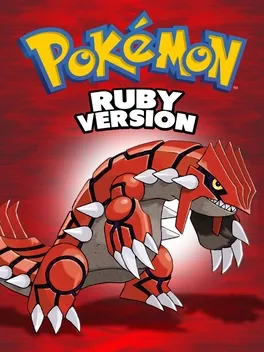
Pokémon Ruby Version
Introduction
Released in late 2002 in Japan and 2003 worldwide, Pokémon Ruby Version (and its sibling Sapphire) represented a monumental shift for the Pokémon franchise. Transitioning from the 8-bit aesthetic of the Game Boy Color to the 32-bit power of the Game Boy Advance, Pokemon Ruby offered a vibrant, colorful world that felt alive in ways previous entries could not match. Known in various territories by titles such as Pokémon Rubis and Pokémon Rubino, this game was more than just a sequel; it was a reimagining of what a monster-collecting RPG could be. As the third generation's flagship, it introduced mechanics that remain foundational to the series today, balancing a longer story campaign with deep technical improvements that appealed to both casual fans and hardcore competitive players alike.
Story & Setting
Set in the Hoenn region—a diverse landmass defined by its balance of volcanoes, dense jungles, and vast oceans—the narrative of Pocket Monsters Ruby is significantly more ambitious than its predecessors. Players take on the role of a young trainer moving to Littleroot Town. Unlike the previous games, where the plot focused primarily on collecting gym badges, Pokémon Ruby Version introduces a dramatic conflict involving Team Magma. This organization seeks to expand the world's landmass by awakening the legendary Groudon. In international versions like Pokémon Rubí or the Chinese 精灵宝可梦:红宝石, players must navigate these environmental stakes while competing against their rival and the Gym Leaders. The inclusion of more scripted story events and a deeper lore regarding ancient Pokémon gave the campaign a much-needed cinematic feel that elevated the RPG experience.
Gameplay
The core of Pokémon Ruby Version is the addition of 135 new species, bringing the total to 386. However, the true innovation lay beneath the surface. This generation introduced "Abilities" and "Natures," which gave each individual Pokémon a unique personality and strategic niche. For example, a Pokémon with the "Intimidate" ability could lower an opponent's attack upon entering battle, while a "Jolly" nature would boost speed at the cost of special attack. Players who played Pokémon Rubin in Germany or other versions across Europe were also introduced to Double Battles, where two Pokémon fight simultaneously on each side. This changed the competitive landscape forever. Beyond combat, the game introduced Pokémon Contests, a non-combat way to interact with your team, and a deep Berry-growing system that utilized the Game Boy Advance's internal clock for real-time growth, adding layers of immersion previously unseen.
This game was released on several platforms, primarily focusing on the handheld power of the Game Boy Advance, which allowed for significantly improved sprites and background environments.
Legacy
The legacy of Pokémon Ruby Version is felt in every subsequent generation. By refining the breeding system and formalizing Individual Values (IVs) and Effort Values (EVs), it laid the groundwork for the modern professional Pokémon circuit. While it initially faced criticism for not allowing players to transfer Pokémon from the first two generations due to technical hardware changes, it eventually became one of the most beloved entries in the series. This popularity led to the highly successful remakes, Omega Ruby and Alpha Sapphire, on the Nintendo 3DS years later. Its influence is a testament to the strength of the Hoenn region's design and the technical leaps made during its development era.
Fun Facts
One of the most intriguing aspects of Pokémon Ruby is the use of Braille puzzles to unlock the legendary titans, Regirock, Regice, and Registeel, which required players to translate real-world Braille from the game manual. Additionally, this was the first game in the series to feature dynamic weather effects like rain, sandstorms, and harsh sunlight that directly impacted the mechanics of battle. Another interesting fact is that the internal battery used for clock-based events often runs dry in original physical cartridges today, freezing time-based events like berry growth unless the hardware is repaired. Finally, the game was the first to introduce the "Secret Base" feature, allowing players to create and decorate their own private hideouts hidden behind trees or rocks throughout the world.