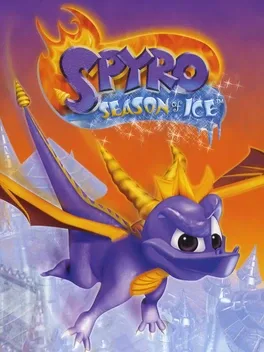
Spyro: Season of Ice
Introduction
Spyro the Dragon became a household name on the original PlayStation, defining the 3D platforming genre alongside icons of the era. However, as the gaming industry transitioned into the early 2000s, the franchise saw its first major structural shift with Spyro: Season of Ice. Released in 2001, this title marked the beloved purple dragon's debut on the Game Boy Advance (GBA) and stood as the first entry in the series not developed by the original creators, Insomniac Games. Often referred to by its alternative title, Spyro Advance, in certain regions, it successfully brought the magic of the Dragon Realms to the palm of players' hands during a pivotal moment in handheld gaming history.
Story & Setting
The narrative of Spyro: Season of Ice begins in the tranquil Dragon Realms shortly after the events of the original PlayStation trilogy. While Spyro and his friend Hunter the Cheetah are taking a much-needed vacation, a mishap occurs involving a magical rhyming spell book and a clumsy ryno-wizard named Grendor. In a misguided attempt to boost his own power, Grendor accidentally casts a spell that freezes fairies across the realms in giant blocks of ice. Spyro, accompanied by his faithful dragonfly companion Sparx, must traverse four distinct seasonal hub worlds—Autumn, Winter, Spring, and Summer—to rescue the frozen fairies and reverse Grendor’s chaotic magic before the villain's transformation becomes permanent.
Gameplay
The most striking change in Spyro: Season of Ice is the shift from a fully 3D environment to an isometric overhead perspective. This 2.5D approach was a creative necessity to accommodate the hardware limitations of the Game Boy Advance, yet the developers managed to retain the core essence of the franchise. Players still have access to Spyro’s iconic moveset: he can breathe fire to defeat enemies, charge with his horns to break obstacles, and glide across wide gaps to reach hidden areas. The game maintains the series' collectathon roots, requiring players to gather gems and rescue fairies to progress.
One of the most impressive technical aspects of the gameplay is found in the flying bonus levels. To recreate the sensation of 3D flight seen on home consoles, the developers utilized Mode 7 technology. This allowed the GBA to simulate a 3D-like perspective by rotating and scaling background layers in real-time, providing a sense of depth as Spyro navigates through hoops and torches. Furthermore, the game includes specialized levels where players control Sparx in a top-down shooter style, adding a layer of mechanical variety that keeps the experience fresh throughout the adventure.
This title was specifically designed to take advantage of Nintendo's handheld capabilities during the early 2000s, marking a significant milestone for the franchise's accessibility and portability.
Legacy
Developed by Digital Eclipse, Spyro: Season of Ice was a commercial success that proved the character could thrive outside of the PlayStation ecosystem and the oversight of Insomniac Games. While contemporary critics noted that the isometric camera could sometimes make precision platforming a challenge, the game was widely praised for its vibrant color palette and faithful recreation of the Spyro atmosphere. Its success paved the way for a successful handheld lineage, including two direct sequels on the GBA: Season of Flame and Attack of the Rhynocs. This "Season" trilogy remains a nostalgic highlight for fans who grew up with the Game Boy Advance.
Fun Facts
- In Japan, the game is officially known as Spyro Advance, which is why that name is still used by many collectors today.
- It was the first Spyro title not developed by Insomniac Games, who had moved on to work on the Ratchet & Clank series.
- The implementation of Mode 7 for the aerial levels was considered a significant technical achievement for a handheld game in 2001.
- The game features over 20 expansive levels, which was a massive amount of content for a portable title at the time.