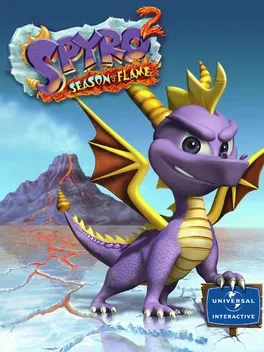
Spyro 2: Season of Flame
Introduction
Following the success of the original PlayStation trilogy, the purple dragon Spyro made a daring leap into the world of handheld gaming. Spyro 2: Season of Flame, released in 2002 for the Game Boy Advance, serves as the direct sequel to Spyro: Season of Ice. Developed by Digital Eclipse, this title aimed to refine the isometric gameplay formula while bringing back the charm and variety that fans expected from the console entries. It remains a standout example of how to adapt a 3D platforming icon into a 2D space without losing the essence of the character, providing a portable adventure that felt remarkably large in scope for its time.
Story & Setting
The narrative picks up shortly after the events of the previous handheld entry. The peace of the Dragon Realms is shattered when a mysterious force—revealed to be the mischievous Rhynocs—steals the fireflies that provide the dragons with their fiery breath. Without the fireflies, the dragons find their powers diminished, often resulting in icy sneezes instead of the usual flames. Spyro, accompanied by his loyal companions Hunter the Cheetah and Bianca the Rabbit, must travel across various themed worlds to recover the stolen fireflies and thwart the Rhynocs' plans. The story brings back a cast of familiar faces, grounding the handheld experience in the established lore of the series while expanding the stakes within the Dragon Realms.
Gameplay
Unlike the full 3D environments of the PlayStation games, Spyro 2: Season of Flame utilizes an isometric perspective. This view allows for a sense of depth while working within the technical limitations of the GBA hardware. The core loop involves exploring expansive levels, collecting gems, and rescuing fireflies. A major addition to this sequel is the ability to toggle between different types of breath. Players can switch between fire and ice breath, a mechanic that is central to solving puzzles and defeating specific enemies. For instance, some objects can only be activated by heat, while others require freezing to become platforms or to neutralize threats.
In addition to Spyro, the game features segments where players control other characters. Sheila the Kangaroo returns with her high-jumping abilities, and Agent 9 provides more action-oriented, projectile-based gameplay. These diversions add significant variety to the pacing, mirroring the multi-character approach found in Year of the Dragon. The level design is intricate, often requiring players to backtrack or use specific abilities to find hidden secrets, ensuring that the exploration feels rewarding despite the fixed camera angle.
This game was released on the Game Boy Advance, allowing players to take Spyro's adventures on the go with vibrant sprite-based graphics.
Legacy
Spyro 2: Season of Flame is often cited as a significant improvement over its predecessor. Reviewers at the time praised the better-controlled movement, more vibrant graphics, and the inclusion of a map system which helped navigate the sometimes confusing isometric levels. It solidified Spyro's presence in the handheld market and demonstrated that Digital Eclipse had a strong grasp on the hardware. While the series eventually moved toward different developers and styles, the "Season" duology on the GBA is remembered fondly by fans for maintaining the spirit of the original Insomniac Games era through its sound design, characterizations, and level themes.
Fun Facts
- Despite being the second Spyro game on GBA, its title Season of Flame is often confused by casual fans with the second PS1 game, which was subtitled Ripto's Rage or Gateway to Glimmer.
- This was the first handheld Spyro game to include multiple playable characters besides the titular dragon himself.
- The fire and ice toggle was a precursor to the more complex elemental breath mechanics seen later in The Legend of Spyro trilogy.
- To capture fireflies, Spyro uses a unique "Bubble Breath," which adds a third layer to the game's elemental mechanics.
- The game's soundtrack was heavily inspired by Stewart Copeland’s original work on the PlayStation series, helping to maintain a consistent atmosphere.