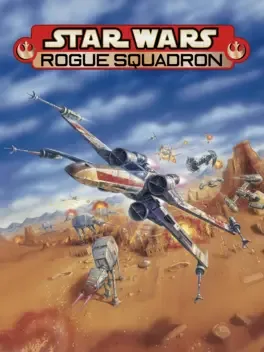
Star Wars: Rogue Squadron
Introduction
Released at the height of Star Wars fever in the late 1990s, Star Wars: Rogue Squadron represents a pivotal moment in gaming history. For the first time, players weren't just participating in the epic space battles seen in the films; they were engaging in intense, planetary-based dogfights that brought the scale of the Galactic Civil War to life. Developed as a collaboration between Factor 5 and LucasArts, the game stripped away the complex simulation elements of previous PC flight sims to focus on high-octane, arcade-style action. Whether you were weaving between the skyscrapers of Imperial-occupied cities or skimming the surface of volcanic worlds, the game captured the sheer thrill of being the galaxy's most elite pilot.
Story & Setting
The narrative of the game is set between the events of A New Hope and The Empire Strikes Back. While the destruction of the first Death Star was a moment of great rejoicing, it did not signal the end of the war. Luke Skywalker, alongside the veteran pilot Wedge Antilles, realizes that the Rebellion needs a specialized unit capable of handling the Empire's most dangerous assignments. Thus, they assemble the Rogue Squadron—a group of twelve of the most skilled, battle-tested starfighter pilots in the fleet.
Players experience the game through the eyes of Luke Skywalker. Known in Japan as Star Wars: Shutsugeki! Rogue Chuutai, the story takes players across various corners of the galaxy. Instead of the deep-space voids seen in many previous titles, the setting focuses on planetary missions, forcing pilots to contend with gravity, terrain, and atmospheric conditions while defending the Rebel Alliance from the Empire's relentless counter-assault.
Gameplay
The gameplay in Star Wars: Rogue Squadron is centered on fast-paced, mission-based combat. Each of the game's 16 main levels presents unique objectives, ranging from reconnaissance and search-and-destroy missions to rescue assignments and bombing runs. Players have access to an iconic hangar of Rebel vessels, including the versatile X-wing, the speedy A-wing, the heavy-hitting Y-wing, and the agile V-wing. On certain missions, such as the famous Battle of Hoth, players take control of a Snowspeeder to utilize its tow cable against Imperial AT-ATs.
Known on the PC as Star Wars: Rogue Squadron 3D, the game features a sophisticated medal system. By completing missions within specific time limits and accuracy thresholds, players can earn Bronze, Silver, or Gold medals. These medals are more than just cosmetic achievements; they are the key to unlocking hidden ships and secret levels, providing immense replay value. The flight controls are intuitive but offer enough depth for skilled players to perform advanced maneuvers to shake off TIE Interceptors and avoid surface-to-air fire.
This game was released on several platforms, including the Nintendo 64 and the PC.
Legacy
Star Wars: Rogue Squadron is remembered as a technical masterpiece for its time. On the Nintendo 64, it was one of the first titles to utilize the Expansion Pak, allowing for a high-resolution 640x480 display that was revolutionary for home consoles in 1998. Its success spawned a legendary trilogy, including Rogue Leader and Rebel Strike on the GameCube, which further pushed the boundaries of visual fidelity.
The game's influence can still be felt in modern Star Wars titles. It proved that there was a massive market for arcade-leaning flight games that prioritized cinematic action over technical complexity. To this day, fans celebrate its tight controls, challenging mission design, and the way it successfully expanded the "Expanded Universe" lore.
Fun Facts
- The Naboo Secret: The Naboo Starfighter from The Phantom Menace was hidden in the game as a secret ship. Because the movie hadn't been released yet, the developers used a special encryption to hide the ship's files, and the code to unlock it wasn't revealed until months later.
- Voice Talent: Mark Hamill did not voice Luke Skywalker in this game; instead, the character was voiced by Bob Bergen, who is also famous for being the voice of Porky Pig.
- Sound Quality: Factor 5 developed a proprietary sound compression technology called MusyX, which allowed the N64 version to have high-quality orchestral music and voice acting despite the storage limitations of cartridges.