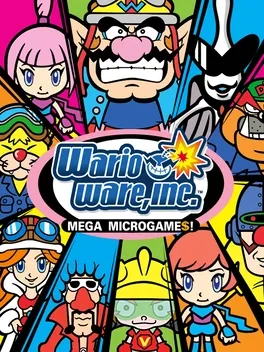
WarioWare, Inc.: Mega Microgame$!
Introduction
Released at the height of the Game Boy Advance's popularity, WarioWare, Inc.: Mega Microgame$! is a high-octane, eccentric, and utterly unique experience that redefined the concept of the "minigame" collection. Developed by Nintendo R&D1, this title marked a radical departure from the traditional platforming adventures of Mario’s greed-driven rival. Known in Japan as Made in Wario and in China as Wǎlìōu Zhìzào (or 瓦力欧制造), the game emphasizes speed, absurdity, and quick reflexes. It challenges players to complete hundreds of seconds-long tasks in rapid succession, creating a chaotic yet addictive rhythm that became a staple of the handheld gaming era.
Story & Setting
The narrative of WarioWare, Inc.: Mega Microgame$! is as zany as its gameplay. The story begins in Diamond City, where Wario, lounging on his sofa, spots a news report about a hit video game. Motivated by his perennial desire for fast cash, he decides to found his own software company: WarioWare, Inc. However, being too lazy to do all the work himself, he recruits a colorful crew of friends and acquaintances to design the games.
This "crazy crew" includes characters like the disco-loving Jimmy T., the tech-obsessed schoolboy 9-Volt, the taxi-driving duo Dribble and Spitz, and the karate-practicing Kat and Ana. Each character brings their own unique theme and visual style to their set of games, ranging from sci-fi and nature to retro Nintendo nostalgia. This bizarre framing device allows for an eclectic mix of art styles and scenarios that keep the player constantly off-balance.
Gameplay
The core of the experience revolves around the "microgame." Unlike standard minigames that might last for several minutes, a microgame in WarioWare lasts roughly three to five seconds. Players are given a single word of instruction—such as "Jump!", "Avoid!", or "Sniff!"—and must immediately figure out the objective using ultra-simple controls. The game primarily utilizes the D-pad and the A button, making it exceptionally easy to pick up and play.
As players blaze through over 200 bizarre microgames, the difficulty ramps up significantly. After a set number of games, the speed increases, and the time limit shrinks, demanding lightning-quick gameplay. Every stage ends with a "Boss Stage," which is a slightly longer, more complex microgame that tests the skills learned during the round. Additionally, the game features innovative two-player contests that can be played on a single Game Boy Advance, with each player grabbing one side of the handheld, further emphasizing the title's creative approach to hardware limitations.
This game was released on several platforms, including the original handheld and later digital re-releases on home and portable consoles.
Legacy
WarioWare, Inc.: Mega Microgame$! is considered a cult classic and a pivotal moment in Nintendo's history. It proved that game design didn't need complexity or high-fidelity graphics to be incredibly engaging; instead, it relied on pure mechanical satisfaction and a surreal sense of humor. The success of the game spawned a long-running franchise that has appeared on every subsequent Nintendo console, often serving as a showcase for new hardware features like touchscreens, motion controls, and IR sensors. Critics at the time praised its innovation, often noting that it felt like a "breath of fresh air" in a market saturated with more traditional genres.
Fun Facts
- The game was developed by a very small team at Nintendo R&D1 who initially worked on the project in secret, using the code name "Idea Notebook."
- In the Chinese market, the game is recognized by the title 瓦力欧制造 (Wǎlìōu Zhìzào).
- Many of the microgames in 9-Volt’s stage are direct references to classic Nintendo products, including the NES, the Game Boy, and even obscure 1970s toys like the Ultra Hand.
- The "Two-Player" mode on a single GBA is one of the few instances in gaming history where two people are encouraged to share the same physical handheld console simultaneously for competitive play.