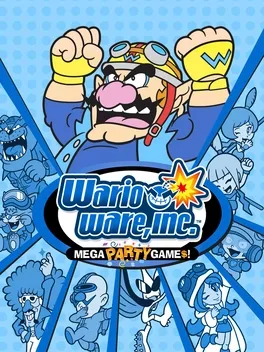
WarioWare, Inc.: Mega Party Games!
Introduction
When WarioWare, Inc.: Mega Microgame$! first debuted on the Game Boy Advance, it took the world by storm with its frantic, five-second "microgames." Following that almost universally acclaimed short-attention-span action, Nintendo decided to bring the chaos to the living room with WarioWare, Inc.: Mega Party Games!. This title serves as a dedicated party-game adaptation for the Nintendo GameCube, taking the core DNA of its handheld predecessor and transforming it into a riotous multiplayer experience. It is a game that defies traditional logic, demanding lightning-fast reflexes and a willingness to embrace the absurd, making it a staple of the GameCube's local multiplayer library.
Story & Setting
Set in the vibrant and eccentric Diamond City, the story follows the ever-greedy Wario, who decides to enter the video game industry to make a quick buck. He recruits a motley crew of friends—ranging from the disco-loving Jimmy T. to the grade-school ninja twins Kat and Ana—to develop hundreds of bizarre microgames. The setting is less about a linear narrative and more about the quirky personalities of these developers. Each character brings their own aesthetic and theme to the proceedings, creating a colorful, pop-art-inspired world where anything can happen. Whether you are in a high-tech lab with Dr. Crygor or a retro arcade with 9-Volt, the goal remains the same: survive the madness and help Wario line his pockets.
Gameplay
The heart of the experience lies in its microgames—bite-sized challenges that last no more than a few seconds. Gamers must strive to be the quickest teeth-brushers, the most precise nose pickers, the best free-throwers, the most accurate apple shooters, and the most skillful paper-airplane pilots. In this GameCube adaptation, the single-player progression is supplemented by robust four-player competition modes. These modes often add a layer of social strategy; for instance, some games require players to complete tasks while their opponents try to distract them or obscure their view.
As in the GBA original, a wide variety of activities combine with a simple, unifying theme designed to appeal instantly to anyone who played video games in the days before 3D graphics and complicated storylines. Half the fun is in not knowing which five-second challenge will pop up next, or what the player will be required to do in it. Even when players aren't in control of the active character, some mini-games allow them to participate in a more passive fashion, such as blowing on the screen or moving obstacles, adding to the group-oriented strategy that makes the game so addictive.
This game was released on the Nintendo GameCube, bringing the handheld frenzy to home consoles for the first time.
Legacy
WarioWare, Inc.: Mega Party Games! is remembered as the title that successfully proved the microgame formula worked just as well in a group setting as it did on a solo handheld. Known in Japan as Atsumare!! Made in Wario, it laid the groundwork for future multiplayer entries in the series, such as WarioWare: Smooth Moves and WarioWare: Get It Together!. Critics praised the game for its accessibility and humor, noting that it was one of the few titles that could be enjoyed by hardcore gamers and non-gamers alike. It remains a cult favorite for retro enthusiasts who value local couch co-op and competitive play.
Fun Facts
- Despite being a new release on the GameCube, the game actually contains all 213 microgames from the original Game Boy Advance version.
- The development of the game was remarkably fast, as it was designed to be a quick follow-up to the GBA success to bolster the GameCube’s software lineup.
- One of the multiplayer modes, "Don't Wake Wario," is a tense game of balance that often results in more laughter than actual winning.
- The Japanese title, Atsumare!! Made in Wario, translates to "Gather Up!! Made in Wario," emphasizing the multiplayer focus.