Mega Man\n\n### Table of Contents\n- Introduction\n- Story & Setting\n- Gameplay\n- Platforms\n- Legacy\n- Fun Facts\n\n## Introduction\nThe year 1987 marked the birth of a legend. Mega Man, originally released as Rockman in Japan, was a pivotal title that helped define the action-platformer genre on the Nintendo Entertainment System. Developed by a small, dedicated team at Capcom, this title represented a significant shift for the company, which had previously focused its efforts on arcade development. Directed by Akira Kitamura and programmed by Nobuyuki Matsushima, the game introduced players to a cybernetic hero whose impact would be felt for decades. Whether you know him as Megaman, Mega Man 1, or by international titles like Мега Мен or 洛克人, the character’s blue armor and arm cannon are instantly recognizable to gamers across the globe. It is the experience that started it all, blending high-quality production with tight, responsive mechanics.\n\n## Story & Setting\nSet in the futuristic year of 200X, the narrative follows the brilliant scientist Dr. Thomas Light and his assistant, Dr. Albert Wily. Together, they created a series of humanoid robots intended to benefit humanity. However, Dr. Wily, fueled by envy and a desire for world domination, betrayed his partner and reprogrammed six powerful Robot Masters to serve his evil ends. In a desperate move to restore peace, Dr. Light’s laboratory assistant, a robot named Rock, volunteered to be converted into a combat machine. Thus, the hero Mega Man was born. The game sets a timeless stage of good versus evil, pitting our hero against a gauntlet of specialized mechanical enemies as he navigates a world filled with high-tech hazards and robotic uprisings to stop Wily from taking over the world.\n\n## Gameplay\nMega Man’s gameplay was revolutionary for its time, introducing a non-linear stage selection process that allowed players to choose their own path. Players must navigate through six distinct stages, each guarded by a unique Robot Master: Cut Man, Guts Man, Ice Man, Bomb Man, Fire Man, and Elec Man. The core mechanic involves the \"Variable Weapons System.\" Upon defeating a boss, Mega Man acquires their specific weapon, which can then be used to exploit the weaknesses of other bosses. This rock-paper-scissors approach to combat added a deep layer of strategy to the intense platforming action. Combined with tight controls, challenging level design, and a memorable soundtrack, the game provides a balanced but challenging experience that rewards skill and experimentation while featuring timeless 8-bit graphics.\n\n## Platforms\nThis game was released on several platforms, including the original NES and its Japanese counterpart, the Family Computer. Over the years, it has seen numerous re-releases on digital storefronts and modern hardware.\n\n
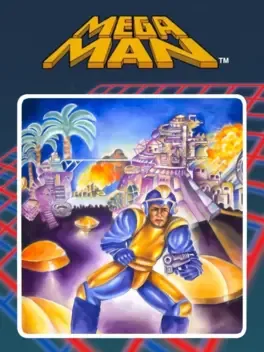
\n\n## Legacy\nThe legacy of Mega Man is immense. It served as the foundation for one of the most iconic video game series in history, spanning over 50 titles across various sub-series like Mega Man X and Mega Man Battle Network. While the initial sales in Japan and North America were modest, critical acclaim and word-of-mouth eventually turned it into a massive success. It is remembered not just for its difficulty, but for its artistic cohesion—uniting vibrant sprite work with iconic music and innovative mechanics. Today, it is regarded as a masterpiece of the 8-bit era and a testament to the creativity of early console game development, having established a template that countless other action games would follow.\n\n## Fun Facts\nInterestingly, Mega Man’s iconic blue color was chosen because the NES had a limited color palette, but specifically offered a wide variety of blue shades, allowing for more visual detail. In the United States, the game is also infamous for its original cover art, which featured a strangely proportioned man in a yellow and blue suit that looked very little like the in-game character. This \"Bad Box Art\" has since become a legendary piece of gaming trivia. Additionally, the development team was remarkably small, consisting of only about six people, which is incredible considering the game's polish and lasting influence on the medium. Before settling on the final name, the character was almost called \"Rainbow Man\" due to his ability to change colors when switching weapons.