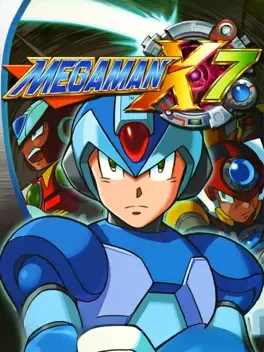
Mega Man X7
Table of Contents
Introduction
The Mega Man X series had long been defined by its precision 2D platforming and high-speed combat. However, with the arrival of the sixth console generation, Capcom sought to push the blue bomber into the third dimension. Released in 2003, Mega Man X7—known in Japan as Rockman X7—represented a radical departure for the franchise. It introduced a new protagonist, a brand-new antagonistic faction, and a hybrid 2.5D and 3D gameplay engine that would change the trajectory of the series forever. While it was a polarizing entry for many longtime fans, its ambition in evolving the formula and expanding the lore of the 22nd century remains a notable chapter in the franchise's history.
Story & Setting
Set in the 22nd century, the world of Mega Man X7 remains a place where humans and "Reploids" (humanoid robots) attempt to coexist. The peace is frequently shattered by Mavericks—Reploids that have gone rogue and turned to violence. Historically, the Maverick Hunters have been the thin line between order and chaos. However, after years of grueling conflict, the veteran hero X has grown weary of the endless cycle of destruction and chooses to retire from active duty, hoping for a more diplomatic solution to the world's problems.
In the vacuum left by the Hunters, a new vigilante group called "Red Alert" emerges. Led by the charismatic Red, this group dispenses a harsher form of justice in newly constructed cities where Maverick crime is on the rise. The plot centers on Axl, a young member of Red Alert with the unique ability to mimic other Reploids. Disillusioned by the group’s increasingly murderous methods, Axl escapes and seeks refuge with the Maverick Hunters, particularly under the wing of the legendary Zero. Red, unwilling to let his prized pupil go, goes on a rampage and issues a challenge to the Hunters: a competition to see who can take down the most Mavericks, with Axl’s freedom as the ultimate prize.
Gameplay
The core gameplay of Mega Man X7 is a hybrid of traditional side-scrolling and full 3D exploration. For the first time, players could swap between two characters in real-time during a mission, allowing for tactical flexibility. The character roster includes the melee-focused Zero, the long-range specialist Axl, and eventually X, once he is unlocked from his retirement.
Axl brings a fresh mechanic to the table: the Copy Shot. This allows him to transform into certain enemies, gaining their physical attributes and abilities, which is used for both combat and environmental puzzles. Zero retains his signature Z-Saber techniques, while X eventually returns with his powerful X-Buster. The game features the classic structure of eight Maverick bosses, such as Flame Hyenard and Ride Boarski, whom the player must defeat to gain new weapons. However, the transition to 3D introduced a lock-on system to assist with aiming, a mechanic that fundamentally altered the series' signature precision-based combat and was a major shift for the Rockman X7 experience.
This game was released on several platforms, including the PlayStation 2 across various regions such as PAL and NTSC territories.
Legacy
Mega Man X7 is often remembered as one of the most experimental and controversial titles in the franchise. The transition to 3D was met with mixed reviews, as many fans felt the controls and camera lacked the tight responsiveness of the earlier 16-bit and 32-bit entries. Despite the criticism, the game’s narrative contributions were significant. It introduced Axl, who would become a permanent and beloved third member of the primary trio in Mega Man X8 and Mega Man X: Command Mission. The game also highlighted the emotional toll of the Maverick Wars on X, adding depth to his character arc beyond just being a soldier.
Fun Facts
- Mega Man X7 marks the only time in the main series where the titular protagonist, X, is not playable from the very beginning of the game. Players must either rescue a specific number of Reploids or defeat the eight main bosses to bring him back into action.
- The Japanese version, Rockman X7, features a high-energy theme song titled "Lazy Mind" by Showtaro Morikubo, who also provided the voice for X in the Japanese release.
- This was the first game in the series to feature full 3D character models and environments, moving away from the hand-drawn or pre-rendered sprites of previous generations. It also featured a more cinematic approach to its storytelling through 3D cutscenes.