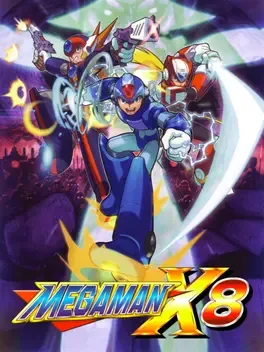
Mega Man X8
Introduction
The Mega Man X series has long been a staple of the action-platformer genre, and Mega Man X8 (widely known in various regions as Megaman X8 or Rockman X8) stands as a significant entry that revitalized the franchise. Released at a time when the series was at a crossroads, this title was designed to satisfy long-time fans while modernizing the aesthetic for a new generation. It successfully transitioned the series back to its side-scrolling roots while maintaining 3D character models and environments, creating a refined 2.5D experience that balanced nostalgia with innovation. For many players, this title represented a crucial return to form, proving that the high-stakes world of Maverick Hunters still had plenty of stories to tell.
Story & Setting
The narrative of Mega Man X8 takes place in a future where Earth has been decimated by continuous Maverick wars and Sigma's repeated invasions. With the planet’s surface becoming increasingly uninhabitable, humanity initiates the "Jakob Project." This ambitious endeavor involves the construction of a massive orbital elevator to transport people and resources to the Moon for colonization. To facilitate this, a new generation of Reploids is developed. These advanced machines are equipped with copy chips that allow them to transform and mimic other Reploids, making them theoretically immune to the Maverick virus. However, the dream of a peaceful exodus is shattered when Lumine, the director of the Jakob Project, is kidnapped by the villainous Vile. X, Zero, and Axl soon discover that the copy chips contain DNA data from the series' primary antagonist, Sigma. This corruption causes the new Reploids to turn on humanity of their own free will, forcing the Maverick Hunters to launch an epic outer-space adventure to save the Earth.
Gameplay
The core loop of MMX8 brings the series back to the high-speed, precision-based platforming that made the original titles famous. Players can choose two out of three playable characters—X, Zero, and Axl—to bring into each mission. The "Double Attack" system is a central feature, allowing players to build up a gauge and unleash a devastating screen-clearing strike with both characters simultaneously. X remains the long-range powerhouse with his variable armor sets; Zero provides high-risk, high-reward melee combat with his Z-Saber; and Axl offers unique mobility with his hovering and rapid-fire capabilities. The game also introduces a deep customization system via the R&D Lab. By collecting "Rare Metals" hidden throughout the stages, players can develop new chips to enhance their characters' health and power. This layer of strategy encourages exploration and replayability, as different character combinations and specific upgrades are often required to tackle the game’s various challenges, mini-bosses, and hidden secrets.
This game was released on several platforms, providing fans across the globe with access to the final mainline entry of the X series on 128-bit hardware.
Legacy
In the broader history of the franchise, Mega Man X8 is often remembered as the "redemption" title. After the mixed reception of the series' previous attempt at full 3D, this game proved that the classic formula still had plenty of life. It was particularly well-received in Asian markets under the title 搑元䅘X8, where the challenging difficulty and complex upgrade systems resonated with the core fanbase. While it would eventually serve as the final numbered entry in the X sub-series for many years, its influence persists. The visual style and tag-team mechanics paved the way for future Mega Man projects and set a high bar for how to modernize a classic 2D IP without losing its mechanical identity.
Fun Facts
- This is the first and only game in the series where the Navigators—Alia, Layer, and Palette—can be unlocked as playable characters, each mirroring the playstyles of X, Zero, and Axl.
- Depending on which character delivers the final blow to the last boss, players can unlock different ending cutscenes and epilogues.
- The orbital elevator, Jakob, is named after the "Jacob's Ladder" biblical story, symbolizing the connection between Earth and Heaven.
- Lumine's design was intentionally made to look more "angelic" compared to previous villains to contrast with the hellish destruction found on the Earth's surface.