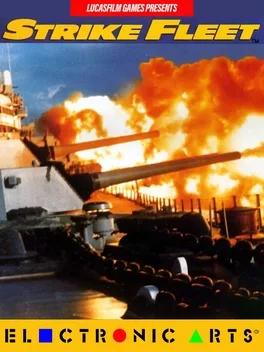
Strike Fleet\n\nIntroduction\nStory & Setting\nGameplay\nPlatforms\nLegacy\nFun Facts\n\n## Introduction\n\nStrike Fleet is a naval military simulator in which the player commands a fleet of warships in real-time through a series of missions inspired by real-life conflicts. Developed by Lucasfilm Games and published by Electronic Arts in the late 1980s, this title brought a level of tactical depth and realism that was rarely seen on home computers of that era. Unlike many arcade-style shooters that dominated the market, the game demanded patience, strategic thinking, and a keen understanding of modern naval technology. It offered players the chance to step onto the bridge of some of the world's most advanced warships, challenging them to manage complex systems while under the constant threat of aerial strikes, submarine ambushes, and surface engagements. The game successfully captured the tension of naval warfare, requiring players to balance aggression with defensive caution in a way that few titles had attempted before.\n\n## Story & Setting\n\nThe narrative landscape of Strike Fleet is grounded firmly in the geopolitical tensions of the late Cold War era. Rather than following a linear plot, the game presents standalone missions and mini-campaigns heavily inspired by real-world events of the 1980s. Players find themselves navigating the volatile waters of the Persian Gulf during the \"Tanker War\" phase of the Iran-Iraq conflict, protecting oil tankers from harassment. Other scenarios take inspiration from the Falklands War, tasking the player with managing British task forces against formidable odds. The game excels at placing the player in high-stakes environments where every radar blip could represent a civilian vessel or a lethal incoming missile. This focus on realistic, contemporary scenarios gave the game a sense of weight and importance, as players were interacting with the same technologies and conflicts seen on the nightly news.\n\n## Gameplay\n\nThe core of Strike Fleet is its sophisticated command interface, which balances real-time action with complex resource management. Players are not just controlling a single ship; they are the commodore of an entire fleet. From the bridge, players can visually identify targets and direct fire, while the tactical map provides a bird's-eye view of the engagement zone. Players must deploy long-range Harpoon missiles against surface threats, use Sea Sparrow missiles for air defense, and rely on the Phalanx CIWS as a last line of defense against incoming projectiles. Anti-submarine warfare is equally tense, requiring the deployment of helicopters and towed sonar arrays to find hidden threats. The game forces players to make split-second decisions: do you activate your radar to find the enemy, knowing that doing so makes you a beacon for their missiles? This risk-reward mechanic is the heart of the experience, ensuring that every encounter feels like a high-stakes chess match on the open sea.\n\n## Platforms\n\nThis game was released on several influential home computer systems, primarily targeting the 8-bit and 16-bit markets of the late eighties.\n\n
\n\n## Legacy\n\nThe legacy of Strike Fleet is defined by its contribution to the \"hard\" simulation genre. At a time when computer hardware was extremely limited, Lucasfilm Games managed to create a believable simulation of modern naval combat that felt authentic. It received high praise from critics for its interface design and the way it made complex military procedures accessible without stripping away their depth. It paved the way for later naval classics like Great Naval Battles and the 688 Attack Sub series. Even decades later, it is remembered fondly by retrogaming enthusiasts for its \"Lucasfilm polish,\" which included impressive documentation and a focus on historical context that few other developers could match. It remains a gold standard for how to translate the complexities of the high seas into a compelling digital experience for home computer users.\n\n## Fun Facts\n\nStrike Fleet was designed by Noah Falstein, who would later become a legendary figure at LucasArts, working on classics like Indiana Jones and the Last Crusade. Despite being a naval sim, the game features the high-quality sound and graphics typical of Lucasfilm's cinematic approach to games. An interesting piece of trivia is that the manual was so detailed it served as a primer on modern naval tactics for many young players. Additionally, while the game is quite serious, it was one of the few titles of its time to accurately depict the fragility of modern warships, where a single missile hit could effectively neutralize a multi-million dollar vessel. This attention to detail helped the game stand out as a premier title for those seeking a more intellectual challenge in their gaming library.