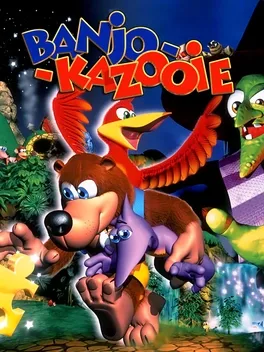
Banjo-Kazooie
Introduction
When the Nintendo 64 era began, the landscape of 3D gaming was being defined by a handful of pioneers. Among the most brilliant was Banjo-Kazooie, a title developed by Rare that refined and perfected the 3D platforming blueprint. Initially conceived during development with the working title Banjo-Kazoo, the game evolved into a vibrant adventure that showcased the developer's trademark charm. Players took control of an inseparable duo—a honey bear and a sharp-witted breegull—whose chemistry remains a highlight of the era. From its lush environments to its quirky soundtrack, the game remains a high-water mark for the genre, combining intricate level design with a sense of humor that was both cheeky and ahead of its time.
Story & Setting
The narrative kicks off in the tranquil Spiral Mountain, where the heroic but somewhat naive bear, Banjo, is fast asleep. His peace is shattered when the hideous and vain witch Gruntilda Winkybunion kidnaps his younger sister, Tooty. Gruntilda’s goal is to use a sinister machine to steal Tooty's beauty for herself to overcome her own repulsive appearance. Realizing the danger, Banjo enlists his smart-mouthed bird buddy Kazooie, who resides in his backpack, to storm the witch’s lair. The game is set within the sprawling corridors of Gruntilda’s Lair, a massive hub world that connects to nine large, open levels. These worlds range from the prehistoric heights of Mumbo's Mountain to the industrial gloom of Rusty Bucket Bay, each offering a distinct aesthetic and a unique set of challenges that push the players to master the duo's abilities.
Gameplay
At its core, Banjo-Kazooie is a 3D platformer that emphasizes exploration and item collection. The player is tasked with finding "Jiggies"—golden jigsaw pieces—which are used to complete paintings that unlock new areas of the lair. Additionally, Musical Notes must be gathered to break magical barriers. The game is distinguished by its novel moveset, where Banjo and Kazooie work in tandem. Early in the game, a friendly mole named Bottles teaches them new maneuvers like the Beak Buster, the Egg Firing, and the Talon Trot, which sees Kazooie carry Banjo at high speeds to climb steep slopes. This synergy is further expanded by the shaman Mumbo Jumbo, who can transform the pair into various creatures like a bumblebee, a walrus, or even a washing machine. These transformations are essential for reaching hidden areas and completing specific tasks, making the gameplay varied and consistently engaging.
This game was released on several platforms, including its legendary debut on the Nintendo 64. In the Japanese market, the title was localized as Banjo to Kazooie no Daibouken, where it also enjoyed significant critical success and helped establish the franchise internationally.
Legacy
The historical significance of Banjo-Kazooie cannot be overstated. Often viewed as the primary rival to Super Mario 64, it pushed the N64 hardware to its limits with large draw distances and detailed textures. It solidified Rare’s reputation as a world-class developer and perfected the "collectathon" style of gameplay that would dominate the late 90s. The sarcastic tone and the "gibberish" style of character dialogue became a staple of the series and influenced countless other games. Even decades later, the game’s impact is felt through high-definition remasters and the inclusion of the characters in crossover fighting games. Its influence persists in the modern era through spiritual successors, proving that the bear and bird still hold a special place in the hearts of gamers.
Fun Facts
One of the most interesting pieces of trivia regarding the game’s development is its origin as Project Dream, a complex RPG for the SNES featuring a human protagonist named Edison. As development shifted to the N64, the project was reimagined as the platformer we know today. Another legendary piece of lore is the "Stop 'n' Swop" feature. Rare originally intended for players to be able to transfer data between the first game and its sequel by quickly swapping game cartridges while the console was still powered on. While technical limitations eventually led to the feature being mostly disabled, the mysterious ice keys and colored eggs remained hidden in the game code for years, fueling endless playground rumors and internet theories before finally being addressed in later re-releases.