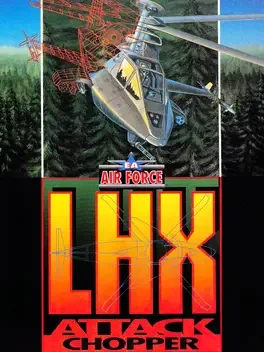
LHX: Attack Chopper
Introduction
Story & Setting
Gameplay
Platforms
Legacy
Fun Facts
Introduction
In the early 1990s, the landscape of home console gaming was dominated by 2D platformers and side-scrolling shooters. However, Electronic Arts dared to bring a more sophisticated, three-dimensional experience to the 16-bit era with LHX: Attack Chopper. As a precursor to the modern military flight simulations we see today, LHX: Attack Chopper offered a unique blend of technical simulation and accessible arcade action. It allowed players to step into the boots of a pilot tasked with navigating high-stakes missions across the globe. Whether you were a seasoned flight enthusiast or a casual gamer looking for something more tactical, LHX delivered an ambitious perspective on modern aerial warfare. Its inclusion of polyhedral graphics marked a significant departure from the pixel art common to the era, signaling a new direction for the industry.
Story & Setting
While LHX: Attack Chopper does not feature a character-driven narrative in the traditional sense, it places the player firmly within the geopolitical tensions of the late Cold War and early post-Cold War eras. The game features three distinct theaters of operation: Libya, East Germany, and Vietnam. Each region offers its own set of environmental challenges and political contexts. In Libya, players find themselves conducting surgical strikes against desert installations. East Germany provides a glimpse into the tensions of a divided Europe, where players navigate forested borders and avoid air defense networks. Finally, the Vietnam theater offers dense jungle terrain where visibility is low and the threat of ground fire is constant. This global variety gives the missions a sense of gravity, framing the player's actions as part of a larger international effort to complete critical military objectives.
Gameplay
The core of LHX: Attack Chopper lies in its flexible approach to mission structure and vehicle selection. Unlike many linear games of the time, LHX allows players to choose their mission order and their aircraft. There are four distinct helicopters available: the heavy-hitting AH-64 Apache, the versatile UH-60 Blackhawk, the innovative tilt-rotor V-22 Osprey, and the titular experimental LHX (Light Helicopter Experimental). Each helicopter has different flight characteristics and weapon capacities. The Apache is the gold standard for pure combat, while the Blackhawk and Osprey are better suited for transport and rescue operations. The LHX represents the cutting edge of stealth and agility. Missions range from simple search and destroy sorties to complex escort and rescue tasks. The gameplay strikes a balance between realism—requiring players to manage fuel, ammunition, and damage—and arcade accessibility. The inclusion of multiple camera angles, including a detailed cockpit view, enhanced the immersion for players seeking a genuine pilot experience on their home consoles.
This game was released on several platforms, including the PC and the Sega Mega Drive and Genesis.
Legacy
The legacy of LHX: Attack Chopper is defined by its technical ambition. Created by Brent Iverson, who would later become a legendary figure in the flight simulation genre, the game was a pioneer in using filled polygon graphics on consoles that were largely designed for 2D sprites. While the frame rate might seem modest by today’s standards, seeing a fully 3D world on a Sega Genesis was a technical marvel in 1992. It paved the way for future titles like the Strike series and influenced how developers approached 3D space on 16-bit hardware. Its legacy lives on in the hearts of retro gaming fans who remember it as one of the first titles to bring hard military hardware and tactical depth into the living room.
Fun Facts
- The LHX acronym stands for Light Helicopter Experimental, a real-world military program that eventually resulted in the RAH-66 Comanche prototype.
- The game features a detailed mission debriefing system that tracks every round fired and missile launched, providing a full statistical breakdown of player performance.
- It was one of the few games on the Genesis that utilized the console's processor to its absolute limit to render 3D polygons without an additional co-processor chip.
- Electronic Arts used this game as a key part of their marketing to show that the Genesis was the grown-up console for serious gamers.
- Developer Brent Iverson also created the critically acclaimed Chuck Yeager's Air Combat, sharing many of the same simulation philosophies found in LHX.