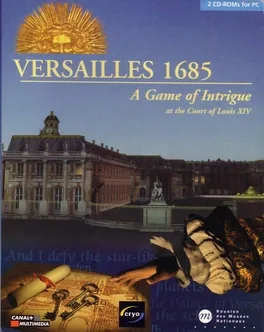
Versailles 1685
Introduction
Step back into the opulence and danger of the French monarchy in "Versailles 1685," a seminal title in the genre of historical adventure games. Developed by Cryo Interactive and published in conjunction with the Réunion des Musées Nationaux, the game offers players an unprecedented look at the court of King Louis XIV. Known in North America as "Versailles: A Game of Intrigue," this title successfully blended rigorous historical research with a compelling detective narrative. Its impact was felt deeply across the continent, becoming a massive commercial hit and proving that educational content could thrive in the mainstream gaming market. The game was a commercial success, with sales of 500,000 units in Europe alone by 2000, signaling a peak for the historical adventure genre.
Story & Setting
The year is 1685, the height of the Sun King's reign. However, beneath the gilded surfaces and rigid etiquette of the palace, a dark plot is brewing. Players take on the role of Lalande, a young courtier tasked by Alexandre Bontemps, the King's trusted valet, to uncover a conspiracy. Someone has threatened to destroy the palace, and it is up to you to identify the culprit before the clock runs out. The setting is a character in itself; the game features a meticulously reconstructed Palace of Versailles, allowing players to walk through the Hall of Mirrors, the Royal Chapel, and the expansive gardens.
In various regions, the game is known by its local titles, such as "Versailles 1685 : Complot à la cour du Roi Soleil" in France and "Versailles 1685: Verschwörung am Hof" in Germany. These titles reflect the central conflict: a race against time to prevent a catastrophe at the heart of French power. The narrative is populated with real historical figures, from members of the royal family to famous artists and architects of the era, making every interaction feel steeped in authenticity and political tension.
Gameplay
"Versailles 1685" utilizes a first-person point-and-click interface, a staple of Cryo Interactive's adventure titles. Players navigate 360-degree pre-rendered environments, searching for clues and interacting with the environment. The core mechanics revolve around inventory management, logic puzzles, and social navigation. To progress, you must master the complex social hierarchy of the court, knowing who to talk to and which gifts or documents to present to gain information without offending the nobility.
A standout feature is the "Omnibus," an integrated encyclopedia that provides detailed historical context for the people, places, and customs encountered during the journey. This "edutainment" approach ensures that while you are solving a mystery, you are also learning about the 17th-century French lifestyle, the specific etiquette of the court, and the political climate of the time. The tension is heightened by a time-sensitive structure, forcing players to be efficient in their investigations as the day progresses toward a potentially explosive climax.
This game was released on several platforms, including the PC and the PlayStation, ensuring that both console and computer users could experience the majesty of the Sun King's court.
Legacy
The legacy of "Versailles 1685" is defined by its remarkable commercial performance and its role in popularizing the "cultural adventure" genre. By 2000, the game had reached a milestone of half a million sales in Europe, a testament to its broad appeal. It demonstrated that there was a hungry audience for games that prioritized atmosphere and historical fidelity over high-octane action. The success of this title led to a sequel and several other historically themed games from Cryo, solidifying their reputation as masters of the educational adventure format. Even decades later, it is remembered as one of the most accurate digital recreations of a historical site ever produced.
Fun Facts
- The development team worked closely with the curators of the Palace of Versailles to ensure that every painting, piece of furniture, and architectural detail was as accurate as possible to the year 1685.
- The game’s soundtrack features authentic Baroque music from the period, including works by Lully and Couperin, which enhances the immersive atmosphere.
- In "Versailles 1685: Verschwörung am Hof," the voice acting was specifically directed to capture the formal and often rigid speech patterns of 17th-century nobility.
- The "Omnibus" feature was so well-regarded that it was often used in French schools as a digital learning tool to teach students about the history of the monarchy.