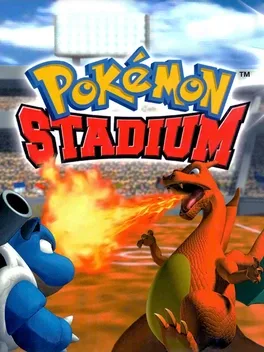
Pokémon Stadium

Pokémon Stadium

Introduction

In the late 1990s, the world was gripped by a phenomenon that transcended mere entertainment. Pokémon had conquered the Game Boy handhelds, but fans were clamoring for something more—a way to see their favorite creatures come to life in full 3D. Pokémon Stadium, also known by its Japanese title Pocket Monsters Stadium 2, became the bridge between the portable world and the home console experience. Released on the Nintendo 64, this game took the strategic depth of the RPG series and stripped away the tall grass and gym leader travels, focusing entirely on the spectacle and strategy of the arena. It was a bold step for the franchise, offering a high-stakes competitive environment that tested even the most seasoned trainers.

Story & Setting

Unlike the mainline handheld titles that defined the series, Pokémon Stadium does not feature a traditional RPG narrative or a sprawling world to explore. Instead, the setting is centered around a massive competitive complex where the world's strongest trainers gather. The narrative is one of personal progression and mastery. Players are not trying to stop an evil organization like Team Rocket; they are trying to cement their status as a legendary trainer. The game captures the atmosphere of a professional sporting event, with a dynamic announcer and a roaring crowd that reacts to every hit, miss, and status condition. This focused setting allowed the developers to pour all their resources into the 3D models and animations of all 151 original Pokémon, making the stadium feel like the center of the Pokémon universe.

Gameplay

The heart of the experience is found in the Stadium Mode. Here, a single player competes in a gauntlet of 80 different battles, which are strategically divided into four major tournaments. Each tournament has its own set of level caps and rules, requiring players to adapt their strategies constantly. If you manage to conquer the Stadium Mode, you earn the right to a bonus battle against the ultimate Pokémon warrior, Mewtwo. This encounter serves as the true climax of the initial game.

However, the challenge doesn't end there. Victory over Mewtwo unlocks a secret mode that presents 80 brand-new, and devilishly tough battles. This mode is where the game's difficulty truly peaks. While players can select rental Pokémon for quick versus and random battles, these pre-set teams are often too predictable because their techniques are not determined by the trainer. There is virtually no way to beat the secret mode without having trained your own, elite Pokémon and importing them into the game. Beyond the single-player grind, the game excels in multiplayer. One to four players can compete against each other or the computer in no-holds-barred battles with highly customizable rules, making it a staple of late-90s social gaming.

Platforms

This title brought the Pokémon franchise to life on home consoles with impressive 3D visuals that were revolutionary for the time. It was released specifically for the Nintendo 64 across various regions.

Legacy

The legacy of Pokémon Stadium is immense. It was the first time fans could see their favorite creatures in three dimensions, performing signature moves with cinematic flair. It set the stage for all future 3D Pokémon spin-offs and even influenced the battle animations in the mainline games decades later. Its introduction of a professional, announcer-led battle system changed the way players perceived Pokémon combat, elevating it from a simple RPG mechanic to a spectator sport. To this day, it is remembered as one of the most challenging and rewarding entries in the entire franchise, often cited for its perfect translation of turn-based mechanics into a console format.

Fun Facts

Interestingly, while known as Pokémon Stadium internationally, it was technically the second Stadium game released in Japan, where it was titled Pocket Monsters Stadium 2. The very first Japanese game only featured 42 Pokémon and was never released elsewhere. Additionally, the game included a suite of beloved mini-games, such as Clefairy Says and Sushi-Go-Round, which provided a fun, lighthearted break from the intense tactical battles of the main tournament cups. The secret mode mentioned by developers is often referred to as Round 2 by the community, signifying its extreme jump in difficulty.

Found 6 item(s) for sale

  • Pokémon Stadium

    Seller: retrogameplace

    Country of origin: Spain

    Status: loose

    Description:

    Uploaded Photo
    Image of
  • Pokémon Stadium

    Seller: retrogameplace

    Country of origin: Spain

    Status: loose

    Description:

    Uploaded Photo
    Image of
  • Pokémon Stadium

    Seller: retrogameplace

    Country of origin: Spain

    Status: loose

    Description:

    Uploaded Photo
    Image of
  • Pokémon Stadium

    Seller: retrogameplace

    Country of origin: Spain

    Status: loose

    Description:

    Uploaded Photo
    Image of
  • Pokémon Stadium

    Seller: retrogameplace

    Country of origin: Spain

    Status: loose

    Description:

    Uploaded Photo
    Image of
  • Pokémon Stadium

    Seller: retrogameplace

    Country of origin: Spain

    Status: loose

    Description:

    Uploaded Photo
    Image of