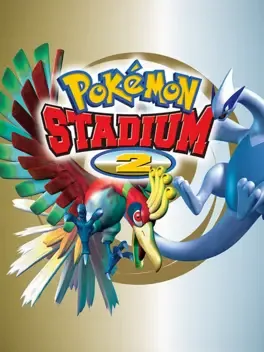
Pokémon Stadium 2
Introduction
Following the massive success of the original Pokémon Stadium, Nintendo and HAL Laboratory brought the Johto region to life with the highly anticipated Pokémon Stadium 2. Known in Japan by the title Pokemon Stadium Kin Gin, this sequel significantly expanded the roster and depth of the series. It allowed players to witness their favorite creatures from both the Kanto and Johto regions in 3D for the first time on the Nintendo 64. The game wasn't just a visual upgrade; it was a comprehensive battle simulator that tested the strategic limits of trainers worldwide. By offering a refined interface and a massive selection of monsters, it remains a cornerstone of the franchise's history on home consoles, providing a bridge for fans of the handheld games to see their teams in full polygonal glory.
Story & Setting
While many associate Pokémon games with a sprawling RPG world, Pokémon Stadium 2—or Pokemon Stadium Gold and Silver as some call it—focuses its narrative on the competitive prestige found within White City. The narrative progress is marked by your rise through the ranks of the Stadium and the Gym Leader Castle. The ultimate goal is to prove your worth as the greatest trainer by defeating the Elite Four and the Johto Gym Leaders. However, the story doesn't end with a simple trophy. Once all the Stadium Cups have been won and the Gym Leader Castle is completed, a mysterious Rival appears. Defeating him doesn't just grant glory; it unlocks the grueling 'Round 2' mode. This secondary quest forces players to re-engage with every challenge but against much smarter AI and entirely different, more powerful Pokémon teams, effectively doubling the game's length and difficulty.
Gameplay
The gameplay of Pokémon Stadium 2 is built around precision and preparation. Players are given access to a staggering pool of 250 different Pokémon, including some legendary Pokémon from the first two generations. The Stadium itself is divided into four major tournaments: the Little Cup, the Prime Cup, and others designed to test specific level ranges or species. Most cups are structured into four tiered rounds—named after Poké Balls like the Great Ball or Ultra Ball—each increasing in difficulty. Before entering a match, you select a team of six but must strategically choose only three to enter the arena after seeing your opponent's lineup. This 'pick-three' mechanic is the heart of the game, requiring players to predict type advantages and status-effect strategies. Beyond the Stadium, the Gym Leader Castle offers a gauntlet of battles against familiar faces like Whitney and Claire, demanding a well-balanced roster to succeed. Each tournament, such as the Little Cup which restricts Pokémon by level and evolution stage, requires a deep understanding of the Gen II meta-game.
This game was released on several platforms, including the nintendo 64.
Legacy
The legacy of Pokémon Stadium Gold Silver is cemented in its role as the ultimate companion piece to the Game Boy Color titles. It provided a visual spectacle that the handhelds couldn't manage, creating a bridge between the 2D sprites and the 3D future of the series. Its influence is still seen in modern Pokémon games, particularly in how battle animations are choreographed. It remains a benchmark for difficulty in the series, as the Round 2 battles are often cited by veterans as some of the toughest AI encounters in Pokémon history. The game's diverse set of mini-games also established a tradition of party-style gameplay within the franchise, proving that the world of Pokémon could be about more than just intense battling.
Fun Facts
Did you know that in Japan, the game is officially titled Pokemon Stadium Kin Gin, which translates to Gold Silver? Another interesting fact is that the game features a Mystery Gift station, allowing players to receive items in their handheld games via the N64. Many fans also refer to it by the long-form name Pokemon Stadium Gold and Silver. Additionally, the game includes an Earl’s Pokémon Academy, which serves as an extensive tutorial and library for the complex mechanics of the second generation, making it an invaluable resource for competitive players at the time. Finally, the mini-games are so well-regarded that they are often played as a standalone party game experience.