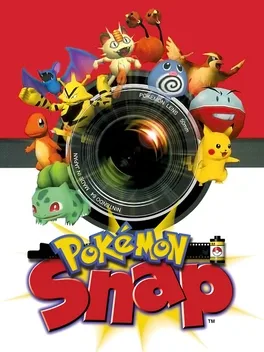
Pokémon Snap
Introduction
In the late 1990s, the Pokémon franchise was taking the world by storm, primarily through its handheld RPGs and animated series. However, Nintendo and HAL Laboratory decided to take a creative risk by introducing a spin-off that deviated entirely from the traditional "catch and battle" loop. This resulted in the release of Pokémon Snap, often referred to as Pokemon Snap in various regions, a unique first-person photography simulation. Instead of using Poké Balls to capture creatures, players used a camera lens to capture their likeness. This title transformed the concept of a rail shooter into a peaceful yet challenging quest for the perfect shot, becoming a beloved cult classic that fans would celebrate for decades to come.
Story & Setting
The narrative centers on Todd Snap, a talented young photographer who is summoned by the world-renowned Professor Oak. The Professor is in the midst of a scientific project and requires high-quality photographs of Pokémon in their natural habitats to complete his research. To facilitate this, Todd is sent to Pokémon Island, a secluded paradise featuring a vast array of diverse geographical locations. From the crashing waves of the Beach and the scorching heat of the Volcano to the eerie depths of the Cave and the lush greenery of the River, the island serves as a vibrant ecosystem. The ultimate goal of the expedition is to uncover the secrets of the island and eventually locate the elusive Mew, a legendary Pokémon whose existence has never been officially recorded.
Gameplay
The gameplay of Pokémon Snap is an "on-rails" experience where players travel through levels in a motorized vehicle called the ZERO-ONE. As the vehicle moves automatically along a set path, players must pan the camera 360 degrees to spot Pokémon hiding in the environment. The core mechanic involves timing and precision; players must take photos while considering size, pose, and technique. After completing a course, Professor Oak evaluates the photos and awards points based on these criteria. High scores are essential for progression, as they unlock helpful items. These include Pokémon Food (apples) to lure creatures closer, Pester Balls to knock them out of hiding or trigger reactions, and the Poké Flute to wake sleeping Pokémon or make them dance. By interacting with the environment, players can trigger unique events, such as evolving a Magikarp into a Gyarados or discovering hidden paths that lead to new areas.
This game was originally a landmark title for its generation and has since been made available on various digital storefronts across subsequent Nintendo consoles.
Legacy
The legacy of Pokémon Snap is defined by its originality and the intense nostalgia it evokes. At the time of its release, it provided the most detailed 3D models of Pokémon ever seen, allowing fans to see their favorite creatures behave like real animals. Its influence persisted for over twenty years, with fans constantly clamoring for a sequel. The game's focus on non-violent interaction and environmental puzzles paved the way for a more observational approach to the Pokémon world. This enduring popularity eventually led to the release of New Pokémon Snap on the Nintendo Switch in 2021, proving that the simple joy of photography remained a powerful draw for the community.
Fun Facts
Interestingly, Pokémon Snap did not start as a Pokémon game at all. It was initially developed as a title called "Jack and the Beanstalk," but was eventually retooled to include the popular pocket monsters to increase its commercial appeal. In the United States, Nintendo partnered with Blockbuster Video to provide "Snap Stations," where players could bring their game cartridges and print out stickers of their in-game photos. Additionally, while the game features many iconic creatures, only 63 out of the original 151 Pokémon appear in the game, a decision made to ensure the highest quality animations for each featured species.