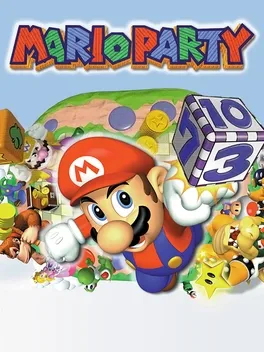
Mario Party
Introduction
When Mario Party first arrived on the scene, it essentially pioneered a new genre of digital board gaming. It brought the iconic characters of the Mushroom Kingdom into a competitive environment that felt more like a physical family game night than a standard platformer. Often referred to by fans in South Korea as "마파," this title transformed the Nintendo 64 into a hub for social gaming. Its brilliance lies in its accessibility; even those who were not seasoned gamers could pick up a controller and understand the objective: move across the board, play fun games, and win stars. It was a chaotic, often hilarious experience that prioritized luck as much as skill, ensuring that no lead was ever truly safe until the final turn was counted.
Story & Setting
The narrative premise of Mario Party is simple yet effective for setting the stage. Mario, Luigi, Peach, Yoshi, Wario, and Donkey Kong find themselves in a heated debate over who among them is the true "Super Star." To resolve this dispute, Toad suggests that they travel through various magical boards to prove their worth. These locations are diverse and visually distinct, ranging from the lush greenery of Yoshi’s Tropical Island to the precarious heights of Eternal Star. Each board is hosted by a different character or theme, providing a unique atmosphere. This playful competition serves as the perfect excuse to pit these legendary heroes and anti-heroes against one another in a quest for glory across the Mushroom Kingdom’s most imaginative landscapes.
Gameplay
The core of Mario Party is its Party Mode, a standard format where up to four players navigate a board to collect stars. Each player’s turn begins with the roll of a die, determining how many spaces they progress. The boards are often non-linear, featuring branching paths that require tactical thinking. To purchase stars, which typically cost twenty coins, players must navigate to the Star Space. This space is elusive, appearing randomly at one of several predetermined locations and moving to a new spot every time a star is acquired. The star space usually moves to occupy a standard blue space after a purchase. Coins are the lifeblood of the game and are primarily earned through minigames. At the end of every turn, a minigame is triggered involving all players. Depending on the spaces players landed on, these games can be free-for-all, 2-on-2, or 1-on-3 configurations. While most games clearly define their teams, some are secretly 4-player co-op experiences where everyone must work together to succeed. With a library ranging from 50 to nearly 110 minigames in the series' earliest iterations, variety is never an issue. Winners usually earn ten coins each, which are used to purchase stars and items.
Mario Party was initially a hallmark title for Nintendo’s 64-bit console, bringing high-quality 3D party gaming into the living room for the first time.
Legacy
The legacy of Mario Party is undeniable. It spawned a massive franchise with over a dozen sequels and spin-offs, maintaining its position as the king of the party game genre. It is famously known as a "friendship-destroyer" because of how quickly fortunes can change—nothing hurts more than having a star stolen right before the finish line. Beyond the memes, the game was a commercial powerhouse and showed Nintendo the potential of localized multiplayer experiences. It set the blueprint for every subsequent entry, establishing the "Party Mode" and minigame structure that remains standard to this day.
Fun Facts
One of the most famous pieces of trivia regarding the original Mario Party involves the physical toll it took on players. Several minigames required players to rotate the analog stick as fast as possible. This led to many players using their palms, resulting in blisters. Nintendo eventually had to offer protective gloves to owners of the game to settle concerns. Additionally, while the game is a competitive race for stars, it was one of the first titles to masterfully blend 2D character sprites with 3D environments on the N64, creating a charming aesthetic that has aged remarkably well.