Mario Party 2
Introduction
The Nintendo 64 era was a golden age for local multiplayer, and few titles embody that competitive spirit better than Mario Party 2. Released in late 1999 in Japan and early 2000 worldwide, this sequel took the foundation laid by its predecessor and polished it to a mirror shine. Whether you know it by its international title or by its Korean shorthand '마파2', the game remains a cornerstone of the "friendship-ending" party genre. It successfully addressed the criticisms of the first entry while introducing mechanics that would become staples of the series for decades to come, proving that Mario and the gang were back for another round of Bowser-bashin' party action that was more refined and exciting than ever before.
Story & Setting
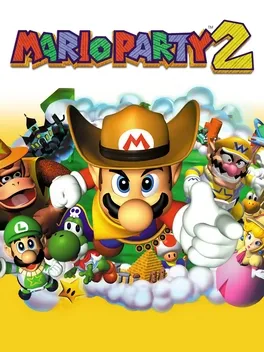
The narrative premise of Mario Party 2 is charmingly theatrical. Mario and his friends decide to open a new theme park called "Mario Land." However, Bowser quickly arrives to crash the party, insisting the park be renamed "Bowser Land." To settle the dispute, the heroes decide to travel through five all-new Adventure Boards to prove who is the true Superstar capable of defeating the Koopa King. The most iconic feature of this game's setting is the costume system. Depending on the board, characters like Mario, Peach, and Yoshi don different duds to match the theme: they become pirates in Pirate Land, cowboys in Western Land, astronauts in Space Land, wizards in Horror Land, and explorers in Mystery Land. This thematic consistency gives each map a unique visual flair and a sense of immersion that later entries in the franchise often struggled to replicate.
Gameplay
At its core, Mario Party 2 is a digital board game where four players compete to collect the most Stars. However, the sequel introduced several game-changing mechanics that added depth to the strategy. The most significant addition was the Item System. Unlike the first game, where items were rare or passive, players could now buy and carry items such as the Plunder Chest to steal from opponents or the Mushroom to roll multiple dice. The board maps are filled with a slew of new tricks and devices, including the train in Western Land and the shifting paths of Mystery Land. Mini-games remain the heart of the experience, with 64 challenges including revamped classics and brand-new additions. The game also introduced "Duel" mini-games, triggered when two players land on the same space during the final five turns, and "Battle" mini-games, where a Goomba forces every player to contribute coins into a massive winner-takes-all pot. These additions made the economy of coins and stars much more volatile and exciting, ensuring that no lead was ever truly safe.
This game was released on several platforms, including the original Nintendo 64 and various digital re-releases on subsequent Nintendo hardware.
Legacy
Mario Party 2 is frequently cited by fans as the definitive entry in the entire franchise. Its legacy is built on its perfect balance of strategy and luck, as well as its commitment to its theatrical adventure theme. Historically, it is also notable for removing the "analog stick rotation" mini-games from the first title, which had notoriously caused physical injuries to players' palms. By refining the controls and introducing the item shop, it set the standard for what a sequel should be: more of the same fun, but with smarter design and better presentation. Its enduring popularity led to its inclusion on the Wii and Wii U Virtual Console services, and it remains a highlight of the Nintendo Switch Online + Expansion Pack library.
Fun Facts
Despite the long-running nature of the series, Mario Party 2 is the only game where the playable characters wear different costumes to match the board's theme throughout the entire match. Another interesting detail is that Bowser adopts a different persona for every board, such as "Captain Bowser" or "Bowser the Brute." Additionally, while the game features many new challenges, several mini-games are actually upgraded "v2" versions of fan favorites from the first Mario Party, featuring improved graphics and adjusted mechanics to remove the need for aggressive stick-spinning. Finally, the game features a secret unlockable board, Bowser Land, which can only be accessed after playing through all the other adventures.