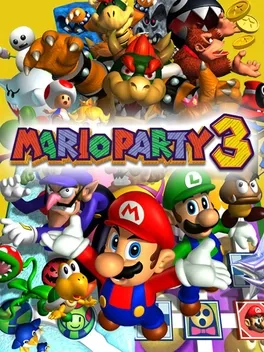
Mario Party 3
Table of Contents
Introduction
Mario Party 3, frequently referred to by fans as MP3 or known in South Korea as 마파3, represents the final chapter of the franchise on the Nintendo 64. Released at the turn of the millennium, it arrived as a definitive celebration of the social gaming genre that the series had pioneered. As the third entry in just three years, it faced the challenge of innovating on a successful formula while maintaining the pick-up-and-play accessibility that made its predecessors legendary. The result was a feature-rich experience that many long-time enthusiasts still consider to be the pinnacle of the original trilogy, offering deeper strategic layers and a more diverse cast than ever before.
Story & Setting
The narrative of Mario Party 3 centers on the sudden appearance of the Millennium Star, a mystical entity that falls from the cosmos directly into Mario's backyard. This event triggers a massive competition among the denizens of the Mushroom Kingdom. To prove who is the true "Superstar," the characters must travel across various themed boards to collect Star Stamps. The setting is notably more structured than previous titles, featuring a dedicated Story Mode where players interact with the Millennium Star and Tumble, a small dice-headed guide. The boards themselves are diverse, ranging from the aquatic depths of Deep Blooper Sea to the chilly heights of Chilly Waters, providing a vibrant backdrop for the high-stakes board game action.
Gameplay
The gameplay of Mario Party 3 refined the classic board game mechanics while introducing bold new modes. While the traditional four-player Battle Royale remains the core focus, the roster was expanded to eight playable characters. This was the first time players could select the mischievous Waluigi or the energetic Princess Daisy. A major innovation in this title is the Duel Map mode. Unlike standard boards, Duel Maps are designed for two players who use non-playable characters (NPCs) as partners—such as Chain Chomps, Goombas, or Bob-ombs—to attack their opponent. Each player has a stamina bar, and the goal is to reduce the rival's health to zero through strategic movement and partner management. Additionally, the game introduced a variety of new items and was the first in the series to offer multiple save slots, allowing different members of a household to track their own progress through the Story Mode.
This game was originally released on the Nintendo 64, seeing distribution across major regions including North America, Europe, and Japan.
Legacy
As the swan song for the series on the Nintendo 64, Mario Party 3 is remembered for its technical polish and for pushing the console's hardware to its limits. It bridged the gap between the experimental nature of the first two games and the more standardized format seen later on the Nintendo GameCube. Its legacy is particularly felt in the competitive community, where the Duel Maps are often cited as a unique highlight that hasn't been fully replicated in the same way in subsequent sequels. The inclusion of Waluigi and Daisy also set the standard for the series' expanded rosters moving forward, cementing their roles as staples in the Mario spin-off universe.
Fun Facts
Mario Party 3 is a treasure trove of historical firsts and lasts for the Mario franchise. It is the first game in the series to feature Luigi's main voice as we know it today. Conversely, it serves as a time capsule for Princess Daisy; it is the final Mario game where she appears in her original yellow and white dress with long hair before her redesign. It also marks the final use of Yoshi's unique "record-scratching" vocal sound effect, a quirk that would not be heard again until the release of New Super Mario Bros. Wii years later. Furthermore, the game’s Duel Mode partners added a tactical depth that made NPCs like the Whomp or Snifit integral to a player's victory strategy.