Found 4 item(s) for sale
-
Games
Send a Message to
-
Games
Send a Message to
-
Games
Send a Message to
-
Games
Send a Message to
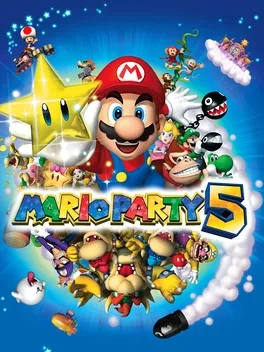
Mario Party 5 represents a significant milestone in the long-running digital board game franchise, marking the series' second outing on the Nintendo GameCube. Developed by Hudson Soft and published by Nintendo in late 2003, it continued the tradition of blending competitive board gaming with chaotic, fast-paced mini-games. As the fifth installment in the main series, it had the difficult task of following up on the massive success of its predecessors while introducing enough innovation to keep the formula fresh for veteran players. With its vibrant graphics, polished mechanics, and a robust selection of modes, Mario Party 5 solidified its place as a staple of local multiplayer gaming during the early 2000s. It successfully managed to capture the frantic energy of the original trilogy while embracing the improved technical power of the GameCube hardware.
Unlike earlier entries that often centered on characters competing to prove who was the "Super Star," Mario Party 5 takes players to the whimsical Dream World, also known as the Dream Depot. This ethereal realm is where the dreams of everyone in the Mushroom Kingdom are kept safe, ensuring that creativity and imagination flourish. The setting is overseen by the legendary Star Spirits, characters who first made their debut in the original Paper Mario on the Nintendo 64. The peaceful atmosphere of the Dream Depot is suddenly threatened when Bowser and his cohort, Koopa Kid, invade the realm. They intend to conquer the Dream World and transform the inhabitants' pleasant dreams into terrifying nightmares. Mario and his companions must navigate various dreamscapes to collect Stars and restore harmony to the realm before Bowser can succeed.
The core gameplay of Mario Party 5 revolves around four players moving across diverse, themed game boards. Players roll a die to navigate spaces, aiming to collect the most Stars by the end of the game. A major innovation in this entry is the introduction of the Capsule System, which replaced the Item Shops seen in previous games. Instead of purchasing items, players receive capsules from machines scattered across the board. These capsules can be used on the player for a cost or thrown onto board spaces to create "Character Spaces" that trigger specific events when landed on. This added a significant layer of tactical randomness to the experience, as the board state was constantly evolving.
The game features over 75 mini-games, categorized into 4-player, 1-vs-3, 2-vs-2, and Battle formats. Beyond the main board game, Mario Party 5 introduced the "Super Duel Mode." This deep sub-game allows players to build custom battle vehicles using parts earned throughout the game. Players can then compete in arenas, adding a vehicle-combat element that was entirely new to the series. The diversity of boards, such as Toy Dream, Sweet Dream, and Bowser’s Nightmare, ensures that every match feels unique and challenging.
This game was released exclusively for the Nintendo GameCube, providing a high-quality local multiplayer experience that utilized the console's four controller ports.
Mario Party 5 is often remembered as a high point for the franchise's presentation and content depth. It was a commercial success, selling millions of copies and proving that the "Party" formula still had plenty of life. While some critics at the time felt the series was becoming annual, fans lauded the improved 3D character models and the sheer variety of mini-games. The introduction of the Capsule system was a bold experiment that influenced how items would be handled in subsequent GameCube entries like Mario Party 6 and 7. Today, it is regarded as a classic example of Nintendo's ability to create competitive fun that appeals to all ages, maintaining a dedicated following among retro gaming enthusiasts.
In some regions, particularly South Korea, the game is frequently referred to by the shorthand name 마파5. This entry also marked the first time Koopa Kid became a playable character in the franchise's history. Furthermore, Mario Party 5 was the game that officially transitioned Donkey Kong from a playable character to a non-playable character who manages the "DK Space," a role he would occupy for several years in the series. Another interesting note is the inclusion of the Star Spirits from Paper Mario, which remains one of the few direct crossovers between the Mario Party series and Mario’s RPG spin-offs. This addition gave the game a unique narrative flair not found in other entries.
Games
Games
Games
Games