Found 3 item(s) for sale
-
Games
Send a Message to
-
Games
Send a Message to
-
Games
Send a Message to
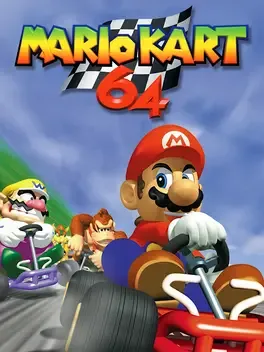
Released in late 1996, Mario Kart 64 (frequently abbreviated as MK64) stands as one of the most influential racing games in history. As the second main installment of the franchise, it had the monumental task of following up the Super Nintendo classic and successfully transitioned the series into the realm of 3D. Known in Japan as Mario Kart Roku-juu Yon, the game became an instant staple for the Nintendo 64, defining the four-player local multiplayer experience for an entire generation. Whether players were navigating the treacherous curves of Bowser's Castle or battling it out in Block Fort, the title offered a level of chaotic fun that few games could match at the time. Its vibrant colors and smooth performance helped cement the Nintendo 64's reputation as the ultimate multiplayer machine of the late nineties.
While Mario Kart 64 is not a narrative-driven game, it is deeply rooted in the colorful world of the Mushroom Kingdom. In this tournament, the most iconic figures from the Super Mario universe gather to compete in the ultimate kart racing circuit. Across various international markets, the game is recognized by several names, including the simplified Chinese 马力欧卡丁车 (Mǎlì'ōu Kǎdīngchē) and the traditional Chinese 瑪利歐賽車64. Regardless of the regional naming, the setting remains a whimsical tour through diverse environments. Racers travel from the sandy shores of Koopa Troopa Beach to the haunted corridors of Banshee Boardwalk, and finally to the celestial heights of Rainbow Road. The game captures the essence of a friendly yet fierce competition where the stakes are bragging rights and the gold trophy.
Mario Kart 64 introduced several major mechanical shifts to the series. It was the first entry to utilize three-dimensional graphics for its track design, allowing for elevation changes, bridges, and tunnels that were impossible in the previous Mode 7 engine. However, to maintain high performance during four-player splitscreen, the characters and items are actually two-dimensional, pre-rendered sprites that rotate to face the camera. The game, known in some regions as Mario Kateu 64 or simply 마카 64, features three engine sizes: 50cc, 100cc, and 150cc, which act as difficulty levels. Each of the eight playable karts has distinctive handling, acceleration, and top speed capabilities. Heavyweights like Wario can bully smaller racers, while lightweights like Toad excel at quick recovery. The combat system remains a highlight, featuring unique power-ups like Green and Red Shells, Bananas that cause skidding, and the devastating Lightning Bolt that shrinks opponents. This entry also famously introduced the Spiny Shell (Blue Shell), which targets the racer in first place, ensuring that no lead is ever truly safe.
This classic title has seen numerous releases over the years, ensuring its availability on both original hardware and modern digital storefronts. It has been localized and titled differently in various markets, sometimes appearing as Mario Kǎdīngchē or Maliou Kadingche in different transliterations. The game remains a popular choice for retro gaming enthusiasts across the globe.
The legacy of Mario Kart 64 is immense. It set the template for every future 3D kart racer, perfecting the balance between racing skill and item-based luck. During its early development, it was actually known as Super Mario Kart R, but the name was changed before its final release. The introduction of four-player simultaneous play was a game-changer, fostering a social gaming culture that persists today. Critics and fans alike praised its track design and replayability, and it remains one of the best-selling games on the Nintendo 64. Its influence can be seen in every modern Mario Kart title, from the drift mechanics to the iconic music tracks that have been remixed for decades.
Interestingly, the game originally featured Magikoopa (Kamek) as a playable character, but he was replaced by Donkey Kong late in development. Another fascinating detail is that while the game is 3D, it uses a technique called 'billboarding' for the racers, which is why they appear as sprites. The 'R' in the prototype title Super Mario Kart R was rumored to stand for 'Rendered.' Additionally, the Japanese version of the game featured different voice acting and parodies of real-world brands (like 'Marioro' instead of Marlboro) on the billboards, which were changed for international releases to avoid legal issues and maintain a family-friendly image.
Games
Games
Games