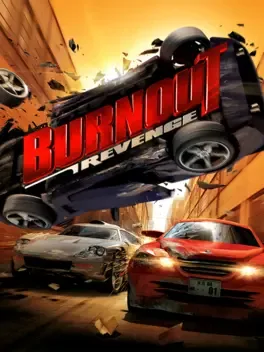
Burnout Revenge
Introduction
Burnout Revenge, occasionally referred to during its development and by fans as Burnout 4, is the high-octane fourth installment in the legendary racing franchise. Released in 2005, it took the established formula of high-speed racing and spectacular crashes and cranked the aggression to maximum levels. While previous entries focused on the thrill of near-misses and precision driving, Revenge shifted the focus toward combat. It isn't just about finishing first; it’s about making sure your rivals don't finish at all. With its blistering sense of speed and a heavy metal aesthetic, it remains one of the most celebrated arcade racers in gaming history.
Story & Setting
While Burnout Revenge lacks a traditional narrative character arc, the "story" is told through the progression of the World Tour. Players are cast as a rising star in the dangerous world of illegal street racing, aiming to become the most feared driver on the planet. The setting spans three continents, featuring meticulously designed tracks that simulate rush-hour traffic in diverse environments. From the neon-lit streets of Tokyo to the industrial heartlands of the United States and the narrow corridors of European cities, the world serves as a playground for destruction. The game captures a gritty, urban atmosphere where every junction is a potential disaster zone and every straightaway is an invitation for chaos.
Gameplay
Gameplay in Burnout Revenge is defined by its brutal aggression. The most significant innovation is "Traffic Checking," a feature that allows players to ram small-to-medium vehicles traveling in the same direction. This turns civilian traffic into projectiles that can be used to take down rivals, a move known as a Traffic Takedown. This mechanic is central to the "Traffic Attack" mode, where players must rack up Crash Dollars by checking as many vehicles as possible.
The game features several distinct event types: Circuit Racing, Road Rage, Burning Lap, and the high-stakes Eliminator, where the last-placed car is detonated every thirty seconds. The fan-favorite Crash Mode also returns, tasking players with causing the most expensive pile-up possible at busy junctions to earn Crash Dollars. A core mechanic is the Revenge Takedown; if a rival takes the player out, that rival is marked with a red arrow, and taking them down in return provides ultimate satisfaction and a full boost refill. Additionally, the Crashbreaker mechanic allows players to detonate their own car after a crash to take out nearby opponents. Progression is managed through a World Tour consisting of 169 events across 11 ranks, with players earning a "Revenge Rank" based on their performance and aggression.
Burnout Revenge was initially released on sixth-generation hardware with a subsequent enhanced release for the seventh generation, offering improved visuals and expanded features.
Legacy
Burnout Revenge is often cited by critics and fans alike as the peak of the series. Its shift toward a more aggressive, combat-oriented racing style was initially controversial but eventually hailed as a masterstroke in arcade game design. The Xbox 360 version, in particular, set a high bar for the early HD era with its particle effects and sense of scale. The game’s influence can be seen in many modern racers that incorporate vehicular combat or cinematic crash cameras. Even years later, the sheer speed and fluid controls of Burnout Revenge make it a staple for those looking for an adrenaline-fueled experience that modern racing titles rarely replicate.
Fun Facts
There are a total of 77 cars to unlock, including specialized SUVs and saloons that are specifically tuned for heavy-duty crashing. The Xbox 360 version introduced "Burnout Clips," an early form of social sharing that allowed players to save and share 30-second replays of their most spectacular moments. Interestingly, while there are 11 ranks in the World Tour, Rank 11 is a special tier that contains no events, serving as a status symbol for those who have mastered the game.