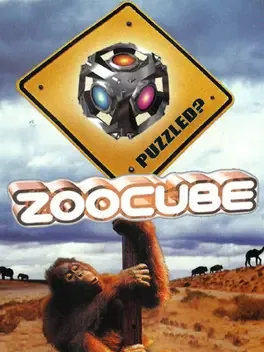
Zoocube
Introduction
In the early 2000s, the puzzle genre was undergoing a significant transformation. As gaming hardware moved firmly into the third dimension, developers sought ways to adapt classic tile-matching and spatial reasoning mechanics into 3D environments. Enter Zoocube, a vibrant and frantic puzzle game developed by PuzzleKings. While many puzzle games of the era remained tethered to two-dimensional grids, Zoocube dared to place the player at the center of a literal cube, challenging their reflexes and spatial awareness from every angle. It offered a refreshing departure from the standard falling-block formula, providing an experience that was as visually stimulating as it was mentally taxing.
Story & Setting
The narrative of Zoocube is as whimsical as its presentation. The world has been thrown into chaos by a series of bizarre, shape-altering science experiments that have gone horribly wrong. These experiments have affected the animal kingdom, stripping various creatures of their natural forms and turning them into geometric, blocky shapes. As a hero in this cuboid world, the player is tasked with rescuing these unfortunate animals and returning them to their natural state. The primary goal is to collect these transformed creatures and guide them safely to the flying ark, a high-tech sanctuary designed to preserve life and reverse the effects of the experiments. The setting moves across various global environments, emphasizing that this animal crisis is a worldwide phenomenon that only the player's quick thinking can solve.
Gameplay
The core gameplay of Zoocube, also known simply as Zoocube in all regions, revolves around a central three-dimensional cube that the player can rotate on multiple axes. Various animal-themed shapes fly from the edges of the screen toward the center. The player's objective is to rotate the cube so that the incoming pieces land on the correct faces. Matching two of the same animal shapes on a single face will "rescue" the animal, clearing the pieces and scoring points. However, the challenge escalates quickly as pieces begin to arrive faster and from different directions. If the pieces pile up too high on any single face of the cube, the game ends. To help manage the chaos, players can earn power-ups and must deal with specific "junk" pieces that complicate the matching process. The game features several modes, including a standard knockout mode, a challenge mode with specific objectives, and a multiplayer mode where players can compete to see who can clear the most animals in the shortest time.
This game was released on several platforms, including the PlayStation 2 and the Nintendo GameCube.
Legacy
Zoocube remains a cult classic among puzzle enthusiasts of the sixth console generation. While it didn't achieve the massive mainstream success of titles like Tetris or Bejeweled, it was praised for its innovative use of 3D space. Critics at the time noted its high difficulty ceiling and addictive nature, often comparing its frantic pace to the best arcade puzzlers. Its legacy lives on as a prime example of the experimentation that defined the early 2000s, proving that the puzzle genre could evolve beyond flat planes and simple grids. For many, it represents a nostalgic era of gaming where mid-tier publishers and developers like PuzzleKings could bring unique, focused concepts to a wide audience.
Fun Facts
- The game was developed by PuzzleKings, a studio that specialized in creating accessible yet challenging puzzle experiences.
- Despite its colorful and child-friendly aesthetic, the higher levels of the game are notoriously difficult, requiring lightning-fast reflexes.
- The Nintendo GameCube version was often cited as having slightly sharper visuals and faster loading times compared to its counterparts.
- Zoocube was one of the few puzzle games of its time to fully utilize the analog sticks of contemporary controllers for 360-degree rotation.